

Latest L5M5 Exam Dumps CIPS Exam from Training Expert PassLeaderVCE
Pass CIPS Managing Ethical Procurement and Supply (L5M5) PDF Dumps | Recently Updated 91 Questions
CIPS L5M5 Exam Syllabus Topics:
| Topic | Details |
|---|---|
| Topic 1 |
|
| Topic 2 |
|
| Topic 3 |
|
NEW QUESTION # 39
People in the UK earn entitlements to Social Security through National Insurance contributions. Under what circumstances are payments provided? Select THREE
- A. Redundancy
- B. Retirement
- C. Sickness
- D. Change of job
- E. Marriage
Answer: A,B,C
Explanation:
Comprehensive and Detailed Explanation From Exact Extract of Documents:
Social Security in the UK provides benefits such as sick pay, redundancy support, pensions, and maternity/paternity payments. The L5M5 study guide (p.93) specifies that payments can be made in cases of sickness (A), loss of employment (B), and retirement (C). Benefits are not provided simply for changing jobs (D) or marriage (E), as these do not affect financial or employment security. Procurement professionals need to understand social security systems, especially when working with international suppliers, since welfare provisions differ globally and affect labour conditions.
Reference: Managing Ethical Procurement and Supply (L5M5) Study Guide, p.93
NEW QUESTION # 40
Rahul, a procurement officer at a textile manufacturing company, aims to engage employees in integrating ESG (environmental, social, and governance) standards into daily operations. Is this an effective strategy?
- A. Yes, because workers have the right to association and CBA
- B. No, because in raising ESG awareness workers have nothing to do
- C. No, for implementing ESG standards there is no need to raise awareness
- D. Yes. Because, Employees are the best promoters and they feel valued if they involved
Answer: D
Explanation:
Choice D- Involving employees in raising sustainability awareness is a good strategy because by involving them, they feel valued and empowered, leading to increased engagement, ownership, and better promotion of sustainability practices. This is the correct answer.
Incorrect answer:
Choice A - This option is incorrect because raising awareness is a crucial step in implementing ESG initiatives. Without awareness, employees may lack the knowledge and motivation to adopt ESG practices, which can hinder the success of such efforts.
Choice B - This option is incorrect because the right to association and collective bargaining (CBA) refers to labor rights, not to ESG awareness. While these rights are important in the workplace, they do not justify involving workers in sustainability initiatives specifically.
Choice C - This option is incorrect because workers/employees are integral to the implementation of ESG practices. They play a key role in daily operations and can influence the organization's sustainability efforts. Claiming they have "nothing to do" disregards their potential contributions and undermines their importance in achieving ESG goals.
Reference:
LO-2.4; Page 224-225; Worker representation, processes and audit trails
NEW QUESTION # 41
Sustainability-related measures such as ESG are mandatory in all countries and compliance is governed by legislation. Is this TRUE?
- A. Yes - it is governed by the ILO
- B. No - it is not mandatory anywhere
- C. Yes - it is mandated by the UN
- D. No - it is only mandatory in some countries
Answer: D
Explanation:
Comprehensive and Detailed Explanation From Exact Extract of Documents:
The L5M5 study guide (p.181) explains that sustainability-related measures, such as ESG, are only mandatory in some countries, not universally. For instance, the UK has legislation banning single-use plastic straws, while other countries may not. International organisations like the UN and ILO promote sustainability, but they cannot impose legislation globally-any treaty or framework must be ratified into national law. This means compliance is fragmented and varies across jurisdictions. Procurement professionals must therefore remain vigilant, as sourcing internationally exposes them to differing sustainability obligations and standards.
Reference: Managing Ethical Procurement and Supply (L5M5) Study Guide, p.181
NEW QUESTION # 42
Ms. Nabila plans to create a CSR plan by involving all internal and external stakeholders of the company. Which TWO key components should she prioritize for the CSR plan?
- A. CSR Strategy
- B. Financial Analysis
- C. Introduction
- D. Refinement
- E. Philanthropic responsibility
Answer: A,D
Explanation:
Key components of a CSR plan
* CSR assessment
* CSR strategy
* CSR commitment to stakeholder engagement
* Implementation plan and activities
* Verification and evaluation of results
* Refinement
Reference:
LO-1.1; Page 8; Analyze the application of ethical and ESG (Environmental, Social and Governance) factors in supple chains
NEW QUESTION # 43
Why is it important for an organization to regularly review and update its internal governance standards? Select any TWO.
- A. To reduce employee turnover by offering higher salaries
- B. To increase the number of suppliers bidding on contracts
- C. To adapt to changes in industry best practices and stakeholder expectations
- D. To ensure compliance with evolving legal and regulatory requirements
Answer: C,D
Explanation:
Choice A - Laws and regulations frequently change, and failing to update governance standards can lead to non-compliance, resulting in legal penalties, reputational damage, or financial losses. Choice C - Governance standards must evolve to reflect new best practices and address stakeholder concerns, ensuring the organization remains competitive and aligned with societal values.
Incorrect answer:
Choice B - While employee retention is important, governance standards are not directly tied to salary adjustments. This option is unrelated to the governance review process.
Choice D- This is not a direct benefit of updating governance standards. Supplier engagement is more related to procurement strategies rather than internal governance.
Reference:
LO-3.3; Page 313-314; Importance of updating internal governance standards
NEW QUESTION # 44
Which of the following is an example of an organisation updating an internal governance standard?
- A. A manufacturer achieves ISO 9001 for the first time
- B. A construction company begins to pay subcontractors the living wage
- C. Shareholders at a publishing house receive an additional dividend
- D. An IT provider updates an SOP to reflect a new version of cyber security software
Answer: D
Explanation:
Comprehensive and Detailed Explanation From Exact Extract of Documents:
Internal governance standards are the policies, procedures, and practices that guide how an organisation operates internally. According to the L5M5 study guide (p.313), updating a Standard Operating Procedure (SOP) is an example of strengthening internal governance. This ensures compliance, consistency, and risk management within an organisation's operations. By contrast, achieving ISO 9001 (A) involves external certification, paying a living wage (C) relates to external social responsibility, and paying dividends (D) relates to shareholder rewards, not governance. Procurement professionals must understand governance frameworks because robust internal governance ensures compliance with ethical procurement standards and reduces risks of malpractice.
Reference: Managing Ethical Procurement and Supply (L5M5) Study Guide, p.313
NEW QUESTION # 45
Which of the following best defines a cartel, and which party in the supply chain is most impacted by it?
- A. A collaboration between manufacturers to innovate; primarily affects suppliers
- B. A formal agreement between competing firms to set prices and limit production; primarily affects consumers
- C. An informal agreement among suppliers to lower costs; primarily affects retailers
- D. A coalition of businesses to increase competition; primarily affects shareholders
Answer: B
Explanation:
Choice A- This accurately describes a cartel. Firms collude to manipulate the market, resulting in higher prices and limited availability of goods. Consumers are directly impacted as they pay more and have fewer choices. Thus Choice A is the correct answer.
Incorrect answer:
Choice B- This describes a scenario more akin to cooperative pricing or collusion among suppliers, but it doesn't capture the essence of a cartel. While it could affect retailers by changing supply costs, it misses the focus on competition and pricing control typical of cartels.
Choice C- This option suggests a positive collaborative effort aimed at innovation, which is not characteristic of cartels. Cartels are generally about restricting competition rather than fostering innovation. Suppliers might be indirectly affected, but it doesn't align with cartel behavior.
Choice D- This is the opposite of what a cartel does. Cartels reduce competition by collaborating to control prices and production. While shareholders may be affected by cartel activities, the primary impact is felt by consumers and the market as a whole.
Reference:
LO-1.1; Page 43; Issues impacting ethical and sustainable procurement and supply: modern slavery, bribery, corruption, fraud and human rights infringements
NEW QUESTION # 46
The Payra 1320MW Thermal Power Plant, one of the largest power producers in Bangladesh, recently halted production due to worker strikes over poor working conditions. This situation is a consequence of which of the following?
- A. Fraud
- B. Corruption
- C. Human rights
- D. Bribery
Answer: C
Explanation: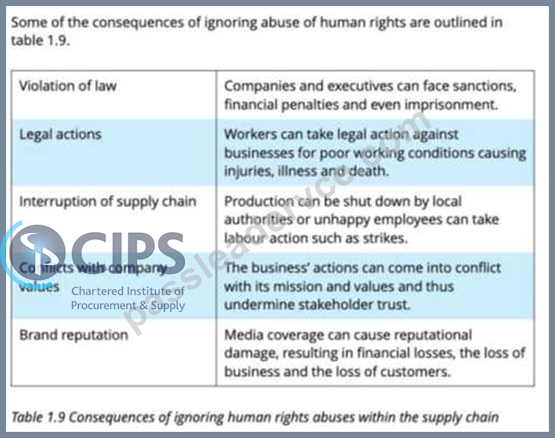
Choice A is the answer as we can see from above interruption of supply chain is a consequence of human rights abuse. The other factors are not directly related to production stoppage due to poor working conditions. Reference: LO-1.1; Page 52; Issues impacting ethical and sustainable procurement and supply: modern slavery, bribery, corruption, fraud and human rights infringements
NEW QUESTION # 47
The development of a documented process to assess the environmental performance of suppliers prior to appointment, would be covered by which part of an ISO 14001:2015 environmental management system?
- A. Performance evaluation
- B. Operation
- C. Support
- D. Context of the organization
Answer: B
Explanation:
Choice B- This is the correct answer. The "Operation" clause of ISO 14001:2015 includes the need for an organization to establish processes for managing external impacts, such as assessing the environmental performance of suppliers and considering their sustainability efforts before appointing them.
Incorrect answer:
Choice A- This part of the ISO 14001:2015 focuses on monitoring, measuring, analyzing, and evaluating the environmental performance of the organization. It is more about assessing the internal processes rather than supplier assessment.
Choice C- This part focuses on understanding the external and internal factors that influence the organization's environmental management system, but not directly on supplier assessment processes.
Choice D- This section covers the resources, competence, awareness, communication, and documented information needed to support the environmental management system, but does not directly address the supplier evaluation process.
Reference:
LO-3.2; Page 284; Role of industry standards and frameworks used by organizations in securing ESG considerations and ethical standards
NEW QUESTION # 48
Which of the following is the correct order of the Deming Cycle?
- A. Plan, do, act, check
- B. Check, plan, do, act
- C. Act, plan, check, do
- D. Plan, do, check, act
Answer: D
Explanation:
Comprehensive and Detailed Explanation From Exact Extract of Documents:
The Deming Cycle (also known as the PDCA cycle) is a continuous improvement model. The correct sequence is: Plan, Do, Check, Act. According to the L5M5 study guide (p.276), it is used within ISO14001 and other management systems to improve processes iteratively. "Plan" involves identifying improvements, "Do" implements them, "Check" monitors results, and "Act" standardises successful changes. Procurement professionals apply this cycle in supplier management and sustainability programmes to ensure continuous improvement.
Reference: Managing Ethical Procurement and Supply (L5M5) Study Guide, p.276
NEW QUESTION # 49
The Modern Slavery Act (2015) ensures supply chains are free from forced and child labour. Which of the following is a limitation of the Act?
- A. It doesn't apply if supply chains are outside the UK
- B. It only applies to companies with a large turnover
- C. There are no repercussions for non-compliance
- D. It is optional to comply with
Answer: B
Explanation:
Comprehensive and Detailed Explanation From Exact Extract of Documents:
The Modern Slavery Act (2015) requires companies with a turnover above £36 million to publish a slavery and human trafficking statement. The L5M5 study guide (p.45) highlights this as a limitation because it excludes smaller businesses, even though they may also operate complex supply chains. The Act applies regardless of where supply chains are located (so A is incorrect), and compliance is mandatory (C is incorrect). Non-compliance can lead to civil proceedings (so D is incorrect). Procurement professionals must be aware of this threshold and ensure compliance in larger organisations.
Reference: Managing Ethical Procurement and Supply (L5M5) Study Guide, p.45
NEW QUESTION # 50
If a company has SA8000 certification, what does this measure?
- A. Social accountability
- B. Quality conformance
- C. Environment
- D. Risk management
Answer: A
Explanation:
Comprehensive and Detailed Explanation From Exact Extract of Documents:
SA8000 is a globally recognised certification standard for Social Accountability. The L5M5 study guide (p.264) confirms that it measures compliance with ethical labour practices such as child labour elimination, safe working conditions, fair wages, and working hours. It does not cover quality (A), environmental management (B), or risk management (C). For procurement professionals, SA8000 provides assurance that suppliers operate ethically, helping organisations meet CSR/ESG commitments across supply chains.
Reference: Managing Ethical Procurement and Supply (L5M5) Study Guide, p.264
NEW QUESTION # 51
Which of the following are effective ways to promote equality in the supply chain? Select any TWO.
1. Fair payment policy
2. Having business integrity
3. Share documents and information on equality
4. Working with businesses that are run by men as they are more hard working
- A. 3 and 4
- B. 2 and 4
- C. 1 and 2
- D. 1 and 3
Answer: D
Explanation:
Choice 1- Having a fair payment policy indicates respect which is one of the ways of ensuring equality in supply chain.
Choice 3- Share documents and information on equality is a way of supporting the supply chain to achieve equality.
Incorrect answer:
Choice 2- While important, business integrity primarily relates to ethical practices and transparency, but does not specifically address equality in the supply chain.
Choice 4- This statement perpetuates gender bias and does not support equality. It is not a valid approach to achieving equality in the supply chain.
Therefore, the correct answer is Option C
Reference:
LO-1.1; Page 36; Role of EDI in securing ethical and sustainable procurement and supply arrangements
NEW QUESTION # 52
Which framework is designed to promote ethical labor practices and social responsibility in global supply chains, addressing issues such as worker rights, health and safety, and fair wages?
- A. OECD (Organization for Economic Co-operation and Development)
- B. SA8000
- C. ETI (Ethical Trading Initiative)
- D. WIETA (Wine and Agricultural Ethical Trading Alliance)
Answer: C
Explanation:
Option A- The Ethical Trading Initiative (ETI) is a UK-based organization that works to improve the working conditions in global supply chains by promoting ethical labor practices. It provides guidelines and a platform for businesses to commit to ensuring workers' rights are upheld, including fair wages, safe working conditions, and the elimination of child labor and forced labor.
Incorrect answer:
Option B- While WIETA (Wine and Agricultural Ethical Trading Alliance) focuses on improving conditions within the South African wine industry, it is more specific to that sector and geography.
Option C- SA8000 is a certification standard for social accountability that focuses on labor rights but is not a framework or initiative aimed at ethical trading across industries.
Option D- The OECD (Organization for Economic Co-operation and Development) provides guidelines on responsible business conduct, but it is broader in scope and not solely focused on labor practices within supply chains.
Reference:
LO-3.1; Page 260-262; Labor codes of conduct: Ethical Trading Initiative (ETI) and Social Accountability International's standard SA8000
NEW QUESTION # 53
Ben & Jerry's products feature a Fair Trade mark, demonstrating their commitment to ethical sourcing. Which of the following strategies do they use to uphold labor standards within their supply chain?
- A. Offering higher prices for all ingredients, regardless of quality
- B. Auditing and reporting on labor practices to ensure compliance
- C. Relying solely on self-reporting from suppliers about labor condition
- D. Implementing a policy that allows for flexibility in labor standards based on local laws
Answer: B
Explanation:
Choice C- By conducting regular audits and reporting on labor practices, Ben & Jerry's ensures that its suppliers adhere to fair labor standards. This process helps identify and address any issues related to working conditions, wages, and worker rights, thereby promoting accountability and transparency within their supply chain.
Incorrect answer:
Choice A- While paying fair prices is important, simply offering higher prices does not guarantee that labor standards are met.
Choice B- This approach can be misleading because self-reporting may not accurately reflect actual conditions without external verification.
Choice D- This could be misleading as it may suggest that local laws can justify subpar labor practices, which contradicts the fair trade ethos.
Reference:
LO-1.3; Page 88-89; Labor standards and working practices
NEW QUESTION # 54
A seafood company in Country Z sources fish from a supplier employing migrant workers. An investigation reveals that the workers were charged excessive recruitment fees, leading to severe debt. Upon arrival, their passports were confiscated, and they were forced to work on fishing vessels for months without fair pay or rest. Those who attempted to leave or report the abuse faced threats of violence. Which labor rights violation best describes this situation?
- A. Forced labor
- B. Child labor
- C. Sexual exploitation
- D. Discrimination
Answer: A
Explanation:
Option C- This scenario involves forced labor because:
Workers were subjected to coercion through confiscation of passports and threats of violence.
They were trapped in abusive working conditions due to debts and lack of freedom to leave. The key elements of forced labor include deception during recruitment, coercion, and lack of consent, all of which are evident in this situation.
Incorrect answer:
Option A- The scenario does not mention minors being employed.
Opton B- No evidence of unequal treatment based on characteristics like gender, race, or religion is mentioned.
Option D- The scenario does not involve sexual abuse or coercion.
Reference:
LO-3.1; Page 250-251; Standards set by the United Nations (UN) and the International Labor Organization (ILO)
NEW QUESTION # 55
Scenario:
Apor is an online retailer of clothing and shoes. It sells four different fashion product lines:
Product 1: Apor has achieved competitive advantage on this product line by producing clothing cheaply. This has been achieved through investment in advanced manufacturing technology, which allows items to be made more cheaply than competitors.
Product 2: Apor is marketing to a younger customer segment for this product and has developed unique features that appeal to teenagers in particular.
Product 3: This product is a specialist type of shoe only purchased by professional dancers. Apor's strategy is to appeal to this small and specific customer segment, and it achieves advantage through low cost of manufacture. However, demand has been affected recently due to import duty and tax changes.
Product 4: The marketing slogan for this product is "Greener Clothing for the Planet". Although slightly more expensive than other ranges, Apor achieves advantage through the product's eco-friendly features, appealing to a smaller, specific segment.
Task:
For each product, match the correct Macro Environment Driver and the correct Source of Competitive Advantage.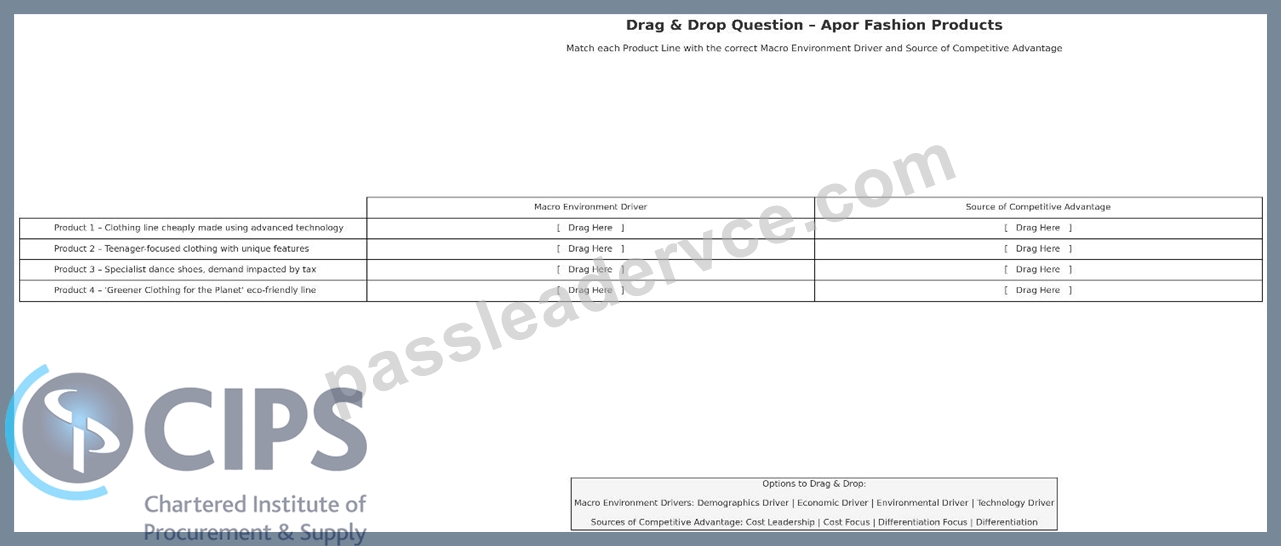
Answer:
Explanation: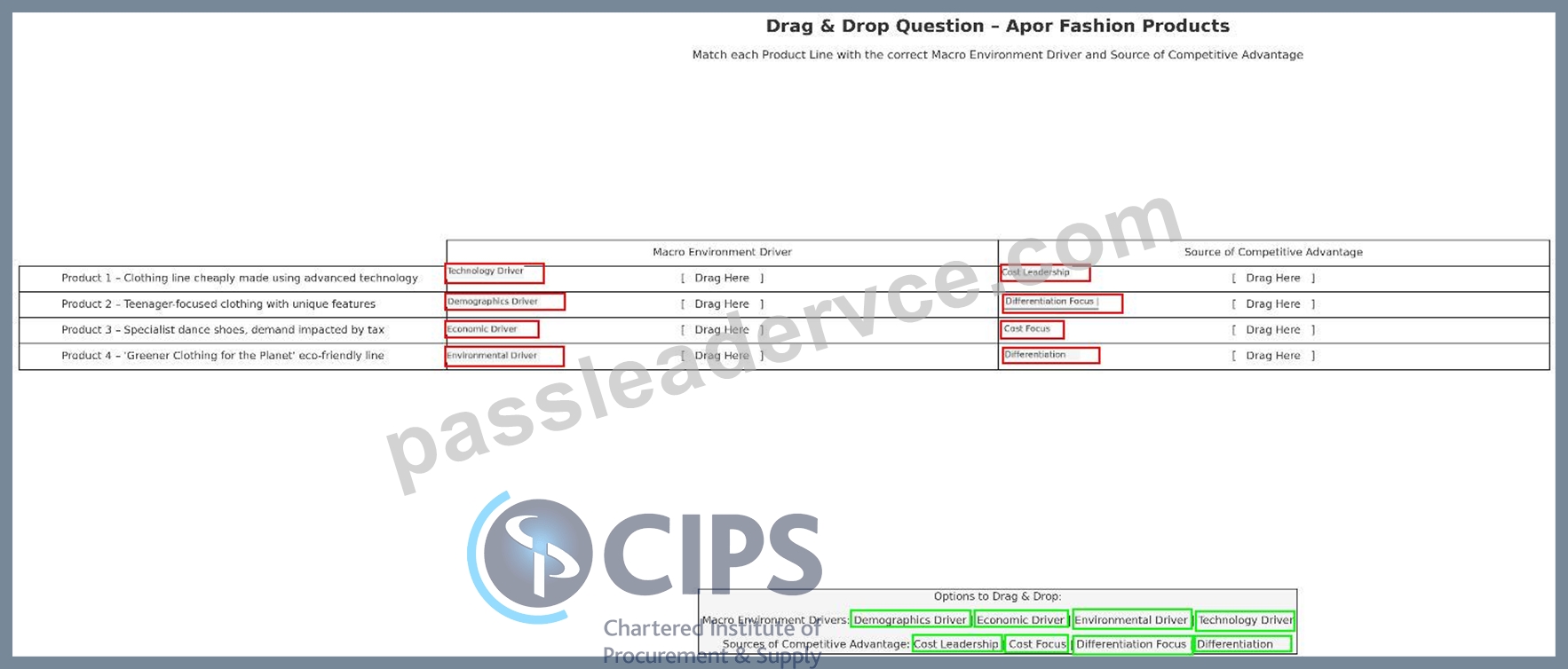
NEW QUESTION # 56
A procurement officer at a global retail company is responsible for sourcing raw materials for a new product line. With the company committed to ethical sourcing practices, including Fair Trade, the officer aims to clearly communicate Fair Trade requirements to potential suppliers. Where should these requirements be included to ensure compliance?
- A. In internal emails to the procurement team
- B. During supplier performance review meetings after contracts are signed
- C. In the company's annual sustainability report
- D. In the specifications section of the tender document
Answer: D
Explanation:
Choice B- Fair Trade requirements must be included in the specifications section of the tender documents so that potential suppliers are aware of and can comply with these requirements before submitting bids or entering into agreements.
Other options, like internal communications or sustainability reports, do not effectively communicate requirements to suppliers in a legally enforceable way.
Reference:
LO-3.3; Page 311-312; Fairtrade standards that affect the workplace and producers and their implications for procurement and supply
NEW QUESTION # 57
GlobalTechManufacturing (GTM), a multinational company, operates a complex supply chain spanning multiple countries and stakeholders. Recognizing this complexity as a major risk, the Chief Supply Chain Officer (CSCO) has launched a supply chain mapping project. The objective is to analyze GTM's supply chain structure and develop risk mitigation strategies. The initial phase of this project will primarily focus on understanding which of the following aspects within GTM's supply chains?
1. Branding
2. Tiers
3. Complexity
4. Innovation
- A. 3 and 4 only
- B. 1 and 4 only
- C. 2 and 3 only
- D. 1 and 2 only
Answer: C
Explanation:
Option 2 - Supply chain mapping involves a detailed analysis of supplier layers, including Tier 1, Tier 2, and Tier 3 suppliers. Identifying these tiers allows GTM to trace the flow of materials, information, and services throughout the supply chain. This visibility is crucial for assessing supplier relationships, dependencies, and risks at each level, helping to mitigate potential disruptions. Therefore, this is a correct answer.
Option 3 - GTM's supply chain is extensive and intricate, spanning multiple countries with interconnected layers. Understanding this complexity helps identify risks, inefficiencies, and bottlenecks. Mapping the network enables GTM to manage interdependencies and enhance supply chain resilience, making this another correct answer.
Incorrect answer:
Option 1- While branding is important for market presence and customer perception, it is not directly related to supply chain mapping or risk mitigation in this context.
Option 4- Innovation is valuable for driving competitive advantage and improving processes, but the focus here is on understanding the current structure of the supply chain to address risks, not on developing new innovations.
By focusing on tiers and complexity, GTM can lay a strong foundation for managing its global supply chain risks effectively thus the answer is Choice A.
Reference:
LO-2.1; Page 145-148; Mapping supply chains to achieve supply chain transparency
NEW QUESTION # 58
Rashed's company is exploring the adoption of the EU's EMAS (Eco-Management and Audit Scheme). What are the key benefits of implementing EMAS?
1. It helps the organization improve its environmental performance and achieve sustainability goals.
2. It guarantees an immediate increase in sales and revenue.
3. It demonstrates compliance with environmental laws and regulations.
4. It offers no costs or resources required for implementation
- A. 3 and 4 only
- B. 1 and 3 only
- C. 1 and 2 only
- D. 2 and 4 only
Answer: B
Explanation:
Option 1- This is correct. EMAS encourages continuous improvement in environmental performance, which is central to the scheme's purpose.
Option 3- This is correct. One of the key benefits of EMAS is helping organizations demonstrate that they comply with environmental legislation, making it easier to meet legal requirements.
Incorrect answer:
Option 2- This is not correct. While EMAS can enhance reputation, it doesn't guarantee immediate sales or revenue growth.
Option 4- This is incorrect. There are costs involved in setting up and maintaining EMAS, such as for auditing and reporting.
Therefore, the answer is Choice B.
Reference:
LO-3.2; Page 279-280; The benefits and challenges of independent standards in securing ESG objectives in ethical and sustainable procurement and supply arrangements
NEW QUESTION # 59
Juicy Boots has a contract with Orange Ltd containing a Retention of Title Clause. Juicy Boots failed to pay for two deliveries, and Orange Ltd reclaims goods already delivered. Is this valid?
- A. No - delivery on time transfers ownership
- B. Yes - the product still belongs to Orange Ltd
- C. No - if Juicy Boots signed for delivery, goods belong to them
- D. Yes - the product can be reclaimed under any circumstances
Answer: B
Explanation:
Comprehensive and Detailed Explanation From Exact Extract of Documents:
A Retention of Title Clause states that ownership of goods remains with the seller until full payment is made. According to the L5M5 study guide (p.190), Orange Ltd legally retains ownership of the fruit delivered until Juicy Boots settles payment. This clause protects suppliers, particularly SMEs, from non-payment risks. Signing for delivery does not override the clause, and timely delivery is irrelevant. Retention of Title is an important risk management tool in procurement contracts.
Reference: Managing Ethical Procurement and Supply (L5M5) Study Guide, p.190
NEW QUESTION # 60
Creating value responsibly for shareholders would sit under which aspect of the sustainability triple bottom line?
- A. Economic
- B. Environmental
- C. Social
- D. Legal
Answer: A
Explanation:
Comprehensive and Detailed Explanation From Exact Extract of Documents:
The economic pillar of the Triple Bottom Line refers to the creation of financial value while maintaining responsibility toward stakeholders. The L5M5 study guide (p.179) explains that sustainability in procurement is not only about compliance with social and environmental standards but also about ensuring financial viability. Activities such as delivering shareholder returns, managing costs, and achieving long-term profitability fall under the economic dimension. "Legal" is not one of the TBL pillars, and while law supports governance, it is not itself a sustainability principle. Therefore, creating value for shareholders through responsible economic performance is clearly categorised under the economic aspect of TBL.
Reference: Managing Ethical Procurement and Supply (L5M5) Study Guide, p.179
NEW QUESTION # 61
Which of the following are benefits to sustainable business practices? Select TWO
- A. increased spending
- B. weakened performance
- C. competitive advantage
- D. increased productivity and reduced waste
Answer: C,D
Explanation:
The two benefits are increased productivity and reduced waste and competitive advantage. The other two options are potential downsides. These types of questions in the exam are pretty straight forward-just look for the logical answer. Benefits and risks of sustainable practices are explained on p.11-14
NEW QUESTION # 62
A manufacturing company experienced frequent breakdowns of a critical machine due to improper maintenance. To resolve this, management is investigating the root cause and implementing measures to prevent future occurrences. What type of plan is the management prioritizing?
- A. Corrective Action Plan
- B. Preventative Action Plan
- C. Root Cause
- D. Risk mitigation plan
Answer: B
Explanation:
Choice B- This is the correct answer because the focus is on implementing measures to prevent future breakdowns and ensure the issue does not recur.
Incorrect answer:
Choice A- This would apply if the management's focus was on fixing the immediate issue (e.g., repairing the broken machine). Since the emphasis is on prevention, this is incorrect.
Choice C- While identifying the root cause is a part of the process, the plan described involves taking preventive action beyond just identifying the cause.
Choice D- This is incorrect because risk mitigation focuses on reducing potential risks, often before they occur. In this case, the issue has already occurred, and the goal is prevention, not general risk management.
Reference:
LO-2.4; Page 229-230; Creating corrective action plans and supplier development programmes
NEW QUESTION # 63
Which organisation is responsible for the creation of the 2030 Sustainable Development Agenda?
- A. UN
- B. ILO
- C. NATO
- D. ISO
Answer: A
Explanation:
This is the UN. There are 17 sustainability goals and these are listed on p.3. For the exam it's a good idea to familiarise yourself with them, but there's no need to learn them all off-by-heart.
NEW QUESTION # 64
......
Updated Test Engine to Practice L5M5 Dumps & Practice Exam: https://www.passleadervce.com/CIPS-Level-5-Advanced-Diploma-in-Procurement-and-Supply/reliable-L5M5-exam-learning-guide.html
Dumps Collection L5M5 Test Engine Dumps Training With 91 Questions: https://drive.google.com/open?id=1ZycHxs1G-rGLydE5ZDho90mR99PqtvVA