

Free CISA Braindumps Download Updated on May 04, 2024 with 927 Questions
ISACA CISA Exam Practice Test Questions
NEW QUESTION # 394
What is used as a control to detect loss, corruption, or duplication of data?
- A. Accuracy check
- B. Hash totals
- C. Redundancy check
- D. Reasonableness check
Answer: B
Explanation:
Section: Protection of Information Assets
Explanation:
Hash totals are used as a control to detect loss, corruption, or duplication of data.
NEW QUESTION # 395
Which of the following network configuration options contains a direct link between any two host machines?
- A. Star
- B. Bus
- C. Ring
- D. Completely connected (mesh)
Answer: D
Explanation:
Explanation/Reference:
Explanation:
A completely connected mesh configuration creates a direct link between any two host machines.
Incorrect answers:
A. A bus configuration links all stations along one transmission line.
B. A ring configuration forms a circle, and all stations are attached to a point on the transmission circle.
D. In a star configuration each station is linked directly to a main hub.
NEW QUESTION # 396
Which of the following would impair the independence of a quality assurance team?
- A. Checking the testing assumptions
- B. Ensuring compliance with development methods
- C. Checking the code to ensure proper documentation
- D. Correcting coding errors during the testing process
Answer: D
Explanation:
Correction of code should not be a responsibility of the quality assurance team as it would not ensure segregation of duties and would impair the team's independence. The other choices are valid quality assurance functions.
NEW QUESTION # 397
Which of the following is the MAIN purpose of data classification?
- A. Defining requirements of security labels
- B. Ensuring the segregation of duties
- C. Applying the appropriate protective measures
- D. Ensuring integrity of sensitive information
Answer: C
Explanation:
Section: Governance and Management of IT
Explanation/Reference:
NEW QUESTION # 398
A database administrator should be prevented from:
- A. having access to production files.
- B. accessing sensitive information.
- C. using an emergency user ID.
- D. having end user responsibilities.
Answer: B
Explanation:
Section: Protection of Information Assets
NEW QUESTION # 399
Reviewing project plans and status reports throughout the development life cycle will:
- A. eliminate the need to perform a risk assessment.
- B. guarantee that the project will meet its intended deliverables.
- C. facilitate the optimal use of resources over the life of the project.
- D. postpone documenting the project's progress until the final phase.
Answer: B
NEW QUESTION # 400
Which of the following is the MOST likely reason an organization would use Platform as a Service (PaaS)?
- A. To develop and integrate its applications
- B. To establish a network and security architecture
- C. To install and manage operating systems
- D. To operate third-party hosted applications
Answer: A
NEW QUESTION # 401
An IS auditor discovers that due to resource constraints a database administrator (DBA) is responsible for developing and executing changes into the production environment Which ot the following should the auditor do FIRSTS
- A. identify whether any compensating controls exist
- B. Determine whether another DBA could make the changes
- C. Report a potential segregation of duties violation
- D. Ensure a change management process is followed prior to implementation
Answer: A
NEW QUESTION # 402
With a properly implemented public key infrastructure (PKI) In use, person A wishes to ensure that an outgoing message can be read only by person B.
To achieve this, the message should be encrypted using which of the following?
- A. Person B's public key
- B. Person B's private key
- C. Person A's private key
- D. Person A's public key
Answer: A
NEW QUESTION # 403
Which of the following is the MOST important consideration when defining recovery point objectives (RPOs)?
- A. Acceptable data loss
- B. Acceptable time for recovery
- C. Minimum operating requirements
- D. Mean time between failures
Answer: A
Explanation:
Section: Protection of Information Assets
Explanation:
Recovery time objectives (RTOs) are the acceptable time delay in availability of business operations, while recovery point objectives (RPOs) are the level of data loss/reworking an organization is willing to accept.
Mean time between failures and minimum operating requirements help in defining recovery strategies.
NEW QUESTION # 404
Which of the following would provide the MOST important input during the planning phase for an audit on the implementation of a bring your own device (BYOD) program?
- A. Results of a risk assessment
- B. Findings from prior audits
- C. Policies including BYOD acceptable user statements
- D. An inventory of personal devices to be connected to the corporate network
Answer: C
NEW QUESTION # 405
Which of the following is MOST important for an IS auditor to ensure is included in a global organization's online data privacy notification to customers?
- A. Consent terms including the purpose of data collection
- B. Industry standards for data breach notification
- C. Consequences to the organization for mishandling the data
- D. Contact information for reporting violations of consent
Answer: A
Explanation:
Section: The process of Auditing Information System
NEW QUESTION # 406
Which of the following attack is also known as Time of Check(TOC)/Time of Use(TOU)?
- A. Eavesdropping
- B. Masquerading
- C. Traffic analysis
- D. Race Condition
Answer: D
Explanation:
Explanation/Reference:
A Race Condition attack is also known as Time of Check(TOC)/Time of Use(TOU).
A race condition is when processes carry out their tasks on a shared resource in an incorrect order. A race condition is possible when two or more processes use a shared resource, as in data within a variable. It is important that the processes carry out their functionality in the correct sequence. If process 2 carried out its task on the data before process 1, the result will be much different than if process1 carried out its tasks on the data before process 2.
In software, when the authentication and authorization steps are split into two functions, there is a possibility an attacker could use a race condition to force the authorization step to be completed before the authentication step. This would be a flaw in the software that the attacker has figured out how to exploit. A race condition occurs when two or more processes use the same resource and the sequences of steps within the software can be carried out in an improper order, something that can drastically affect the output.
So, an attacker can force the authorization step to take place before the authentication step and gain unauthorized access to a resource.
The following answers are incorrect:
Eavesdropping - is the act of secretly listening to the private conversation of others without their consent, as defined by Black's Law Dictionary. This is commonly thought to be unethical and there is an old adage that "eavesdroppers seldom hear anything good of themselves...eavesdroppers always try to listen to matters that concern them."
Traffic analysis - is the process of intercepting and examining messages in order to deduce information from patterns in communication. It can be performed even when the messages are encrypted and cannot be decrypted. In general, the greater the number of messages observed, or even intercepted and stored, the more can be inferred from the traffic. Traffic analysis can be performed in the context of military intelligence, counter-intelligence, or pattern-of-life analysis, and is a concern in computer security.
Masquerading - A masquerade attack is an attack that uses a fake identity, such as a network identity, to gain unauthorized access to personal computer information through legitimate access identification. If an authorization process is not fully protected, it can become extremely vulnerable to a masquerade attack.
Masquerade attacks can be perpetrated using stolen passwords and logons, by locating gaps in programs, or by finding a way around the authentication process. The attack can be triggered either by someone within the organization or by an outsider if the organization is connected to a public network. The amount of access masquerade attackers get depends on the level of authorization they've managed to attain. As such, masquerade attackers can have a full smorgasbord of cyber crime opportunities if they've gained the highest access authority to a business organization. Personal attacks, although less common, can also be harmful.
Following reference(s) were/was used to create this question:
CISA review manual 2014 Page number 324
Official ISC2 guide to CISSP CBK 3rd Edition Page number 66
CISSP All-In-One Exam guide 6th Edition Page Number 161
NEW QUESTION # 407
In an organization, the responsibilities for IT security are clearly assigned and enforced and an IT security risk and impact analysis is consistently performed. This represents which level of ranking in the information security governance maturity model?
- A. Repeatable
- B. Defined
- C. Managed
- D. Optimized
Answer: C
Explanation:
Section: Protection of Information Assets
Explanation:
Boards of directors and executive management can use the information security governance maturity model to establish rankings for security in their organizations. The ranks are nonexistent, initial, repeatable, defined, managed and optimized. When the responsibilities for IT security in an organization are clearly assigned and enforced and an IT security risk and impact analysis is consistently performed, it is said to be
'managed and measurable.'
NEW QUESTION # 408
Which of the following term in business continuity determines the maximum tolerable amount of time that is needed to verify the system and/or data integrity?
- A. RPO
- B. RTO
- C. MTD
- D. WRT
Answer: D
Explanation:
Explanation/Reference:
The Work Recovery Time (WRT) determines the maximum tolerable amount of time that is needed to verify the system and/or data integrity. This could be, for example, checking the databases and logs, making sure the applications or services are running and are available. In most cases those tasks are performed by application administrator, database administrator etc. When all systems affected by the disaster are verified and/or recovered, the environment is ready to resume the production again.
For your exam you should know below information about RPO, RTO, WRT and MTD:
Stage 1: Business as usual
Business as usual
Image Reference - http://defaultreasoning.files.wordpress.com/2013/12/bcdr-01.png At this stage all systems are running production and working correctly.
Stage 2: Disaster occurs
Disaster Occurs
Image Reference - http://defaultreasoning.files.wordpress.com/2013/12/bcdr-02.png On a given point in time, disaster occurs and systems needs to be recovered. At this point the Recovery Point Objective (RPO) determines the maximum acceptable amount of data loss measured in time. For example, the maximum tolerable data loss is 15 minutes.
Stage 3: Recovery
Recovery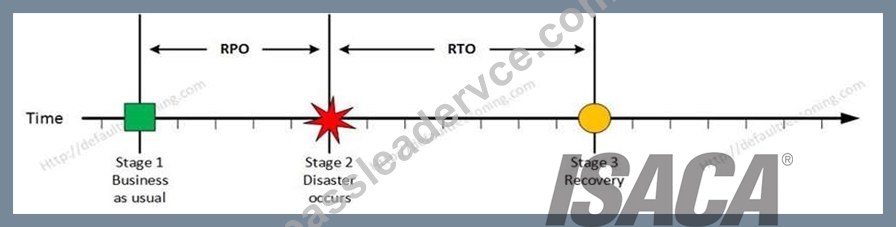
Image Reference - http://defaultreasoning.files.wordpress.com/2013/12/bcdr-03.png At this stage the system are recovered and back online but not ready for production yet. The Recovery Time Objective (RTO) determines the maximum tolerable amount of time needed to bring all critical systems back online. This covers, for example, restore data from back-up or fix of a failure. In most cases this part is carried out by system administrator, network administrator, storage administrator etc.
Stage 4: Resume Production
Resume Production
Image Reference - http://defaultreasoning.files.wordpress.com/2013/12/bcdr-04.png At this stage all systems are recovered, integrity of the system or data is verified and all critical systems can resume normal operations. The Work Recovery Time (WRT) determines the maximum tolerable amount of time that is needed to verify the system and/or data integrity. This could be, for example, checking the databases and logs, making sure the applications or services are running and are available.
In most cases those tasks are performed by application administrator, database administrator etc. When all systems affected by the disaster are verified and/or recovered, the environment is ready to resume the production again.
MTD
Image Reference - http://defaultreasoning.files.wordpress.com/2013/12/bcdr-05.png The sum of RTO and WRT is defined as the Maximum Tolerable Downtime (MTD) which defines the total amount of time that a business process can be disrupted without causing any unacceptable consequences. This value should be defined by the business management team or someone like CTO, CIO or IT manager.
The following answers are incorrect:
RPO - Recovery Point Objective (RPO) determines the maximum acceptable amount of data loss measured in time. For example, the maximum tolerable data loss is 15 minutes.
RTO - The Recovery Time Objective (RTO) determines the maximum tolerable amount of time needed to bring all critical systems back online. This covers, for example, restore data from back-up or fix of a failure.
In most cases this part is carried out by system administrator, network administrator, storage administrator etc.
MTD - The sum of RTO and WRT is defined as the Maximum Tolerable Downtime (MTD) which defines the total amount of time that a business process can be disrupted without causing any unacceptable consequences. This value should be defined by the business management team or someone like CTO, CIO or IT manager.
The following reference(s) were/was used to create this question:
CISA review manual 2014 page number 284
http://defaultreasoning.com/2013/12/10/rpo-rto-wrt-mtdwth/
NEW QUESTION # 409
......
Refund policy for the ISACA CISA Dumps
You have purchased the premium of exam dumps and after purchase, you feel no improvement and think you can not get a good score, you can claim a refund of the fee you paid to leverage these braindumps. So, it is an opportunity for all the candidates to take a step to their certificate earning and career growth. If you earn a certification, you can review and can publish comments about the exam dumps, on the website that the exam dumps told about the CISA exam and supported in preparation as it guaranteed.
Updated Verified CISA dumps Q&As - Pass Guarantee or Full Refund: https://www.passleadervce.com/Certified-Information-Systems-Auditor/reliable-CISA-exam-learning-guide.html
Updated Certification Exam CISA Dumps - Practice Test Questions: https://drive.google.com/open?id=1INmN_ojVrkIJeeo9NRbMmQhKzUatDL5f