

Get Microsoft AZ-700 Dumps Questions [2022] To Gain Brilliant Result
AZ-700 dumps - PassLeaderVCE - 100% Passing Guarantee
Starting a New Career by getting Microsoft AZ-700 certification?
An individual can use Microsoft AZ-700 certification as a first step for a new career. Internal IT professionals can use Azure to provide software, data, and even services to internal users. Azure offers the best features for an organizations technology needs. This certification can help an individual find an opportunity in their areas of expertise. Devised for use by learners that are self-paced in Microsoft Azure. Delegation is a structure that allows a user to perform a task for a specific time period. Azure offers an opportunity for an individual to gain experience from learning how to use the system. Virtual Machines are where virtual machines store their data. Tls protocol encryption is necessary for secure data transfers between two networks. Troubleshooting a network connection can be a difficult task if a person lacks the skills. Learning how to troubleshoot a network connection is crucial for an IT professional to find a tech job. Microsoft AZ-700 Dumps offers an individual the chance to learn when they can use it in their career. Azure offers tools of tech resources, which can make it easier for an individual to find tech related jobs. Affiliate assistance can be beneficial for an individual who wants a change in their current situation. An affiliate assistance program will help an individual by offering resources so they can get their life back on track.
Hybrid networks are networks that contain a combination of private and public resources. Azure is a private cloud deployment of Microsoft Azure. Backends are used to store backend data. Backends are not directly accessible by the public. Backup is the process of saving data so that it can be restored at a later time. Backups are usually performed using hardware appliances using software agents. Backup is necessary for the organization to have the most stable services. Subscription based services that offer a number of features to subscribers. Subscribing to backup services can help an individual protect their data. A feature known as the Azure Backup Vault is a place where backups are stored efficiently. Onmicrosoft technical support can help an individual with any customer service questions. Registered users can access the self-service dashboard to manage data. Aware of the various ways to get help from the community for an individual who has any questions. Supplier signed up for an Azure support plan can provide technical support to help IT professionals.
Certification Topics of Microsoft AZ-700 Exam
Our Microsoft AZ-700 exam dumps covers the following objectives of the Microsoft AZ-700 Exam.
- Secure and monitor networks (15-20%)
- Design, implement and manage hybrid networking (10-15%)
- Design and implement routing (25-30%)
- Design and implement Private access to Azure Services (10-15%)
- Design and implement core networking infrastructure (20-25%)
NEW QUESTION 31
You have Azure App Service apps in the West US Azure region as shown in the following table.
You need to ensure that all the apps can access the resources in a virtual network named Vnet1 without forwarding traffic through the internet-How many integration subnets should you create?
- A. 0
- B. 1
- C. 2
- D. 3
- E. 4
Answer: B
NEW QUESTION 32
Which virtual machines can VM1 and VM4 ping successfully? To answer, select the appropriate options in the answer area.
NOTE: Each correct selection is worth one point.
Answer:
Explanation:
NEW QUESTION 33
Note: This question is part of a series of questions that present the same scenario. Each question in the series contains a unique solution that might meet the stated goals. Some question sets might have more than one correct solution, while others might not have a correct solution.
After you answer a question in this section, you will NOT be able to return to it. As a result, these questions will not appear in the review screen.
You have an Azure application gateway that has Azure Web Application Firewall (WAF) enabled.
You configure the application gateway to direct traffic to the URL of the application gateway.
You attempt to access the URL and receive an HTTP 403 error. You view the diagnostics log and discover the following error.
You need to ensure that the URL is accessible through the application gateway.
Solution: You add a rewrite rule for the host header.
Does this meet the goal?
- A. Yes
- B. No
Answer: B
NEW QUESTION 34
You have an Azure Traffic Manager parent profile named TM1. TM1 has two child profiles named TM2 and TM3.
TM1 uses the performance traffic-routing method and has the endpoints shown in the following table.
TM2 uses the weighted traffic-routing method with MinChildEndpoint = 2 and has the endpoints shown in the following table.
TM3 uses priority traffic-routing method and has the endpoints shown in the following table.
The App2, App4, and App6 endpoints have a degraded monitoring status.
To which endpoint is traffic directed? To answer, select the appropriate options in the answer area.
NOTE: Each correct selection is worth one point
Answer:
Explanation: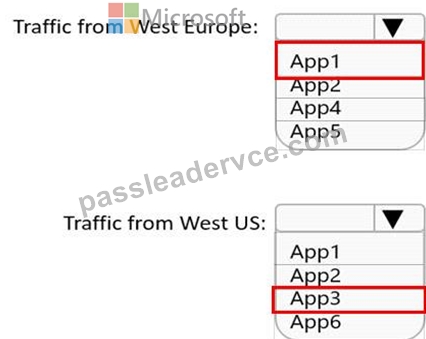
Reference:
https://docs.microsoft.com/en-us/azure/traffic-manager/traffic-manager-nested-profiles
NEW QUESTION 35
You have an Azure Front Door instance that provides access to a web app. The web app uses a hostname of www.contoso.com.
You have the routing rules shown in the following table.
Which rule will apply to each incoming request? To answer, select the appropriate options in the answer area.
NOTE: Each correct selection is worth one point
Answer:
Explanation:
Reference:
https://docs.microsoft.com/en-us/azure/frontdoor/front-door-route-matching
NEW QUESTION 36
You have an Azure Traffic Manager parent profile named TM1. TM1 has two child profiles named TM2 and TM3.
TM1 uses the performance traffic-routing method and has the endpoints shown in the following table.
TM2 uses the weighted traffic-routing method with MinChildEndpoint = 2 and has the endpoints shown in the following table.
TM3 uses priority traffic-routing method and has the endpoints shown in the following table.
The App2, App4, and App6 endpoints have a degraded monitoring status.
To which endpoint is traffic directed? To answer, select the appropriate options in the answer area.
NOTE: Each correct selection is worth one point
Answer:
Explanation:
Explanation
Diagram Description automatically generated
Reference:
https://docs.microsoft.com/en-us/azure/traffic-manager/traffic-manager-nested-profiles
NEW QUESTION 37
Note: This question is part of a series of questions that present the same scenario. Each question in the series contains a unique solution that might meet the stated goals. Some question sets might have more than one correct solution, while others might not have a correct solution.
After you answer a question in this section, you will NOT be able to return to it. As a result, these questions will not appear in the review screen.
You have two Azure virtual networks named Vnet1 and Vnet2.
You have a Windows 10 device named Client1 that connects to Vnet1 by using a Point-to-Site (P2S) IKEv2 VPN.
You implement virtual network peering between Vnet1 and Vnet2. Vnet1 allows gateway transit. Vnet2 can use the remote gateway.
You discover that Client1 cannot communicate with Vnet2.
You need to ensure that Client1 can communicate with Vnet2.
Solution: You download and reinstall the VPN client configuration.
Does this meet the goal?
- A. No
- B. Yes
Answer: B
Explanation:
The VPN client must be downloaded again if any changes are made to VNet peering or the network topology.
Reference:
https://docs.microsoft.com/en-us/azure/vpn-gateway/vpn-gateway-about-point-to-site-routing
Topic 1, Contoso
Existing Environment:
Azure Network Infrastructure
Contoso has an Azure Active Directory (Azure AD) tenant named contoso.com.
The Azure subscription contains the virtual networks shown in the following table.
Vnet1 contains a virtual network gateway named GW1.
Azure Virtual Machines
The Azure subscription contains virtual machines that run Windows Server 2019 as shown in the following table.
The NSGs are associated to the network interfaces on the virtual machines. Each NSG has one custom security rule that allows RDP connections from the internet. The firewall on each virtual machine allows ICMP traffic.
An application security group named ASG1 is associated to the network interface of VM1.
Azure Private DNS Zones
The Azure subscription contains the Azure private DNS zones shown in the following table.
Zone1.contoso.com has the virtual network links shown in the following table.
Other Azure Resources
The Azure subscription contains additional resources as shown in the following table.
Requirements:
Virtual Network Requirements
Contoso has the following virtual networks requirements:
* Create a virtual network named Vnet6 in West US that will contain the following resources and configurations:
Two container groups that connect to Vnet6
Three virtual machines that connect to Vnet6
Allow VPN connections to be established to Vnet6
Allow the resources in Vnet6 to access KeyVault1, DB1, and Vnet1 over the Microsoft backbone network
* The virtual machines in Vnet4 and Vnet5 must be able to communicate over the Microsoft backbone network.
* A virtual machine named VM-Analyze will be deployed to Subnet1. VM-Analyze must inspect the outbound network traffic from Subnet2 to the internet.
Network Security Requirements
Contoso has the following network security requirements:
* Configure Azure Active Directory (Azure AD) authentication for Point-to-Site (P2S) VPN users.
* Enable NSG flow logs for NSG3 and NSG4.
* Create an NSG named NSG10 that will be associated to Vnet1/Subnet1 and will have the custom inbound security rules shown in the following table.
* Create an NSG named NSG11 that will be associated to Vnet1/Subnet2 and will have the custom outbound security rules shown in the following table.
NEW QUESTION 38
You have an Azure virtual network that contains two subnets named Subnet1 and Subnet2. Subnet1 contains a virtual machine named VM1. Subnet2 contains a virtual machine named VM2.
You have two network security groups (NSGs) named NSG1 and NSG2. NSG1 has 100 inbound security rules and is associated to VM1. NSG2 has 200 inbound security rules and is associated to Subnet1.
VM2 cannot connect to VM1.
You suspect that an NSG rule blocks connectivity.
You need to identify which rule blocks the connection. The issue must be resolved as quickly as possible.
Which Azure Network Watcher feature should you use?
- A. NSG diagnostic
- B. Connection troubleshoot
- C. Effective security rules
- D. NSG flow logs
Answer: A
NEW QUESTION 39
You configure a route table named RT1 that has the routes shown in the following table.
You have an Azure virtual network named Vnet1 that has the subnets shown in the following table.
You have the resources shown in the following table.
Vnet1 connects to an ExpressRoute circuit. The on-premises router advertises the following routes:
* 0.0.0.0/0
* 10.0.0.0/16
For each of the following statements, select Yes if the statement is true. Otherwise, select No. NOTE: Each correct selection is worth one point.
Answer:
Explanation:
NEW QUESTION 40
You have the Azure resources shown in the following table.
You configure storage1 to provide access to the subnet in Vnet1 by using a service endpoint.
You need to ensure that you can use the service endpoint to connect to the read-only endpoint of storage1 in the paired Azure region.
What should you do first?
- A. Fail over storage1 to the paired Azure region.
- B. Configure the firewall settings for storage1.
- C. Create a virtual network in the paired Azure region.
- D. Create another service endpoint.
Answer: B
NEW QUESTION 41
You plan to deploy an Azure virtual network.
You need to design the subnets.
Which three types of resources require a dedicated subnet? Each correct answer presents a complete solution.
NOTE: Each correct selection is worth one point.
- A. Azure Private Link
- B. Azure Application Gateway v2
- C. Azure Active Directory Domain Services (Azure AD DS)
- D. VPN gateway
- E. Azure Bastion
Answer: B,D,E
Explanation:
Reference:
https://docs.microsoft.com/en-us/azure/virtual-network/virtual-network-for-azure-services
NEW QUESTION 42
You have two Azure subscriptions named Subscnption1 and Subscription2. Subscription1 contains a virtual network named Vnet1. Vnet1 contains an application server. Subscription2 contains a virtual network named Vnet2.
You need to provide the virtual machines in Vnet2 with access to the application server in Vnet1 by using a private endpoint.
Which four actions should you perform in sequence? To answer, move the appropriate actions from the list of actions to the answer area and arrange them in the correct order.
Answer:
Explanation:
1 - In Subscription1, accept the private endpoint connection request.
2 - Enable virtual network peering between Vnet1 and Vnet2.
3 - Deploy an Azure Standard Load Balancer in front of the application server.
4 - In Subscription1, create a private link service and attach the service to the frontend IP configuration of the load balancer.
NEW QUESTION 43
You are implementing the virtual network requirements for VM Analyze.
What should you include in a custom route that is linked to Subnet2? To answer, select the appropriate options in the answer area.
NOTE: Each correct selection is worth one point.
Answer:
Explanation:
Reference:
https://docs.microsoft.com/en-us/azure/virtual-network/virtual-networks-udr-overview
NEW QUESTION 44
Note: This question is part of a series of questions that present the same scenario. Each question in the series contains a unique solution that might meet stated goals. Some question sets might have more than one correct solution, while others might not have a correct solution.
After you answer a question in this section, you will NOT be able to return to it. As a result, these questions will not appear in the review screen.
You have an Azure subscription that contains the following resources:
* A virtual network named Vnet1
* A subnet named Subnet1 in Vnet1
* A virtual machine named VM1 that connects to Subnet1
* Three storage accounts named storage1, storage2. and storage3
You need to ensure that VM1 can access storage1. VM1 must be prevented from accessing any other storage accounts.
Solution: You create a network security group (NSG). You configure a service tag for MicrosoftStorage and link the tag to Subnet1.
Does this meet the goal?
- A. Yes
- B. No
Answer: B
NEW QUESTION 45
You have an Azure virtual network named Vnet1 that hosts an Azure firewall named FW1 and 150 virtual machines. Vnet1 is linked to a private DNS zone named contoso.com. All the virtual machines have their name registered in the contoso.com zone.
Vnet1 connects to an on-premises datacenter by using ExpressRoute.
You need to ensure that on-premises DNS servers can resolve the names in the contoso.com zone.
Which two actions should you perform? Each correct answer presents part of the solution.
NOTE: Each correct selection is worth one point.
- A. On the on-premises DNS servers, configure forwarders that point to the Azure provided DNS service at 168.63.129.16.
- B. For FW1, configure a custom DNS server.
- C. For FW1, enable DNS proxy.
- D. On the on-premises DNS servers, configure forwarders that point to the frontend IP address of FW1.
- E. Modify the DNS server settings of Vnet1.
Answer: D,E
NEW QUESTION 46
You need to connect Vnet2 and Vnet3. The solution must meet the virtual networking requirements and the business requirements.
Which two actions should you include in the solution? Each correct answer presents part of the solution.
NOTE: Each correct selection is worth one point.
- A. On the peerings from Vnet2 and Vnet3, select Use remote gateways.
- B. On the peering from Vnet1, select Allow gateway transit.
- C. On the peering from Vnet1, select Use remote gateways.
- D. On the peerings from Vnet2 and Vnet3, select Allow gateway transit.
- E. On the peering from Vnet1, select Allow forwarded traffic.
Answer: B,E
NEW QUESTION 47
You have an Azure subscription.
You have the on-premises sites shown the following table.
You plan to deploy Azure Virtual WAN.
You are evaluating Virtual WAN Basic and Virtual WAN Standard.
Which type of Virtual WAN can you use for each site? To answer, select the appropriate options in the answer area.
NOTE: Each correct selection is worth one point.
Answer:
Explanation:
NEW QUESTION 48
You have an Azure virtual network that contains a subnet named Subnet1. Subnet1 is associated to a network security group (NSG) named NSG1. NSG1 blocks all outbound traffic that is not allowed explicitly.
Subnet1 contains virtual machines that must communicate with the Azure Cosmos DB service.
You need to create an outbound security rule in NSG1 to enable the virtual machines to connect to Azure Cosmos DB.
What should you include in the solution?
- A. a private endpoint
- B. a subnet delegation
- C. a service tag
- D. an application security group
Answer: C
Explanation:
Reference:
https://docs.microsoft.com/en-us/azure/virtual-network/service-tags-overview
NEW QUESTION 49
Your company has an Azure virtual network named Vnet1 that uses an IP address space of 192.168.0.0/20. Vnet1 contains a subnet named Subnet1 that uses an IP address space of 192.168.0.0/24.
You create an IPv6 address range to Vnet1 by using a CIDR suffix of /48.
You need to enable the virtual machines on Subnet1 to communicate with each other by using IPv6 addresses assigned by the company. The solution must minimize the number of additional IPv4 addresses.
What should you do? To answer, select the appropriate options in the answer area.
NOTE: Each correct selection is worth one point.
Answer:
Explanation:
Reference:
https://docs.microsoft.com/en-us/azure/virtual-network/ipv6-overview
https://docs.microsoft.com/en-us/azure/virtual-network/ipv6-add-to-existing-vnet-powershell
NEW QUESTION 50
You have the hybrid network shown in the Network Diagram exhibit.
You have a peering connection between Vnet1 and Vnet2 as shown in the Peering-Vnet1-Vnet2 exhibit.
You have a peering connection between Vnet1 and Vnet3 as shown in the Peering -Vnet1-Vnet3 exhibit.
For each of the following statements, select Yes if the statement is true. Otherwise, select No.
NOTE: Each correct selection is worth one point.
Answer:
Explanation:
NEW QUESTION 51
You need to implement name resolution for the cloud.liwareinc.com. The solution must meet the networking requirements.
What should you do? To answer, select the appropriate options in the answer area.
NOTE: Each correct selection is worth one point.
Answer:
Explanation:
Explanation
Graphical user interface, text, application Description automatically generated
Reference:
https://docs.microsoft.com/en-us/azure/dns/private-dns-autoregistration
https://docs.microsoft.com/en-us/azure/virtual-network/virtual-networks-name-resolution-for-vms-and-role-insta
NEW QUESTION 52
Your company has 10 instances of a web service. Each instance is hosted in a different Azure region and is accessible through a public endpoint.
The development department at the company is creating an application named App1. Every 10 minutes. App1 will use a list of end points and connect to the first available endpoint.
You plan to use Azure Traffic Manager to maintain the list of endpoints.
You need to configure a Traffic Manager profile that will minimize the impact of DNS caching.
What should you configure? To answer, select the appropriate options in the answer area.
NOTE: Each correct selection is worth one point.
Answer:
Explanation:
NEW QUESTION 53
......
Get 100% Passing Success With True AZ-700 Exam: https://www.passleadervce.com/Microsoft-Certified-Azure-Network-Engineer-Associate/reliable-AZ-700-exam-learning-guide.html
Premium Quality Microsoft AZ-700 Online dumps: https://drive.google.com/open?id=1HWpFY1V0W1kJseuIiifjPBDSPt7AmNkq