

Pass Your JN0-649 Exam at the First Try with 100% Real Exam Questions
New Juniper JN0-649 Dumps & Questions Updated on 2025
The JN0-649 certification exam is designed to test your knowledge and proficiency in a wide range of topics, including routing protocols, switching technologies, network security, and automation. JN0-649 exam is intended for individuals who have a solid understanding of networking fundamentals and have experience working with Junos OS, Juniper's industry-leading network operating system. Earning this certification demonstrates to employers and peers that you have the necessary skills and knowledge to design, deploy, and manage complex enterprise networks using Juniper technologies.
The JN0-649 exam is considered to be a professional-level exam that evaluates a candidate's ability to configure, troubleshoot, and manage Junos devices. It is an essential exam for network professionals who want to demonstrate their expertise in Juniper's routing and switching technologies.
Juniper JN0-649 certification is a valuable credential for networking professionals who want to advance their careers. It demonstrates that they have the knowledge and skills required to work with Juniper Networks devices in an enterprise environment. Holding this certification can lead to better job opportunities, higher salaries, and increased credibility in the industry.
NEW QUESTION # 68
You are deploying IP phones in your enterprise networks. When plugged in, the IP phones must be automatically provided with the correct VLAN ID needed for sending voice traffic to the EX Series switches.
In this scenario, which two solutions are required to accomplish this task? (Choose two.)
- A. Enable the voice VLAN feature with the appropriate access interfaces and VLAN ID for voice traffic.
- B. Enable LLDP-MED on appropriate access interfaces.
- C. Create two VLANs and assign them as VLAN members to the appropriate access interfaces.
- D. Use LLDP on appropriate interfaces.
Answer: A,B
NEW QUESTION # 69
You want to provide Layer 2 connectivity between campus sites using Ethernet switches through a metro Ethernet service provider who is using Q-in-Q tagging on their network.
Referring to the exhibit, what are two design considerations in this environment? (Choose two.)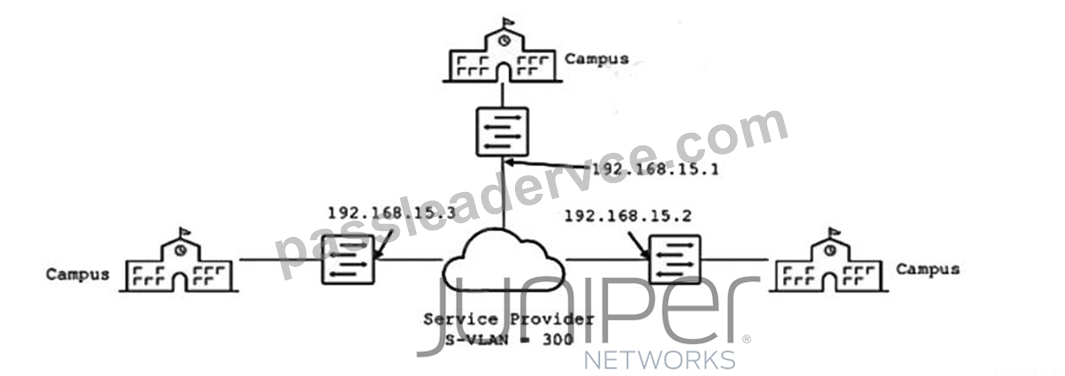
- A. L2PT is required on the SP network to support the spanning tree protocol.
- B. Each campus switch shown must have S-Tag 300 configured.
- C. VXLAN could be implemented on your network across this service provider network.
- D. Each campus switch shown must have a C-Tag 300 configured.
Answer: A,C
Explanation:
* Understanding the Problem:
* The requirement is to provide Layer 2 connectivity between campus sites using Ethernet switches through a metro Ethernet service provider who is using Q-in-Q tagging.
* Design Considerations:
* VXLAN Implementation:
* VXLAN (Virtual Extensible LAN) can be used to extend Layer 2 networks over Layer 3 networks. It is often used to provide scalability and flexibility in modern data center networks. In this case, VXLAN could be used to encapsulate Layer 2 frames within UDP packets, allowing them to be transported over the service provider's network.
* S-Tag Configuration:
* Q-in-Q tagging, also known as 802.1ad, involves an outer tag (S-Tag) and an inner tag (C-Tag). The service provider network uses the S-Tag to identify and segregate customer traffic. Therefore, each campus switch must have the correct S-Tag (300 in this case) configured to ensure the service provider can correctly handle and route the traffic.
References:
* Juniper Networks: Understanding VXLAN
* Configuring Q-in-Q Tagging
NEW QUESTION # 70
You will to route Layer 3 PVLAN traffic within the secondary VLAN.
What is required to accomplish this task?
- A. an FBF policy
- B. an isolated VLAN
- C. an IRB
- D. a community VIAN
Answer: C
NEW QUESTION # 71
You are asked to establish full connectivity between all devices in the BGP network. Referring to the exhibit, which two configuration changes will allow BGP route advertisements? (Choose two.)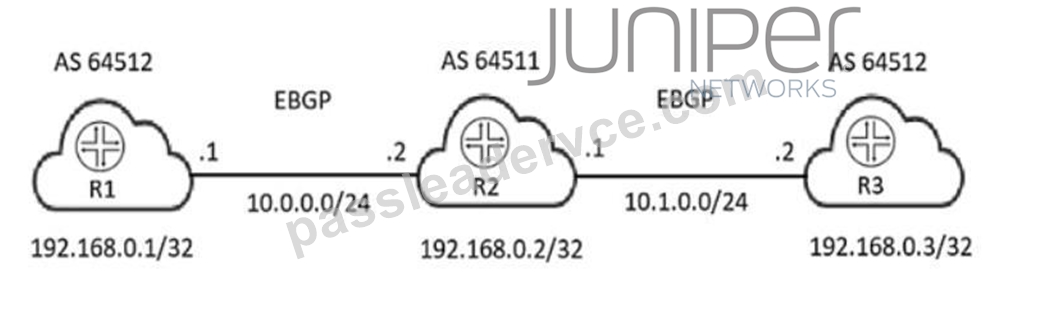
- A. On R2, include the loops 2 statement at the [edit protocols bgp family inet unicast] hierarchy.
- B. On R1 and R3, include the loops 2 statement at the [edit protocols bgp family inet unicast] hierarchy.
- C. On R2, include the advertise-peer-as statement at the [edit protocols bgp group external] hierarchy.
- D. On R1 and R3, include the advertise-peer-as statement at the [edit protocols bgp group external] hierarchy.
Answer: B,C
Explanation:
https://www.juniper.net/documentation/us/en/software/junos/routing-
policy/bgp/topics/example/bgp-advertise-peer-as.html
NEW QUESTION # 72
A BGP network has been designed to provide resiliency and redundancy to a multihomed customer network.
Which two statements are correct in this scenario? (Choose two.)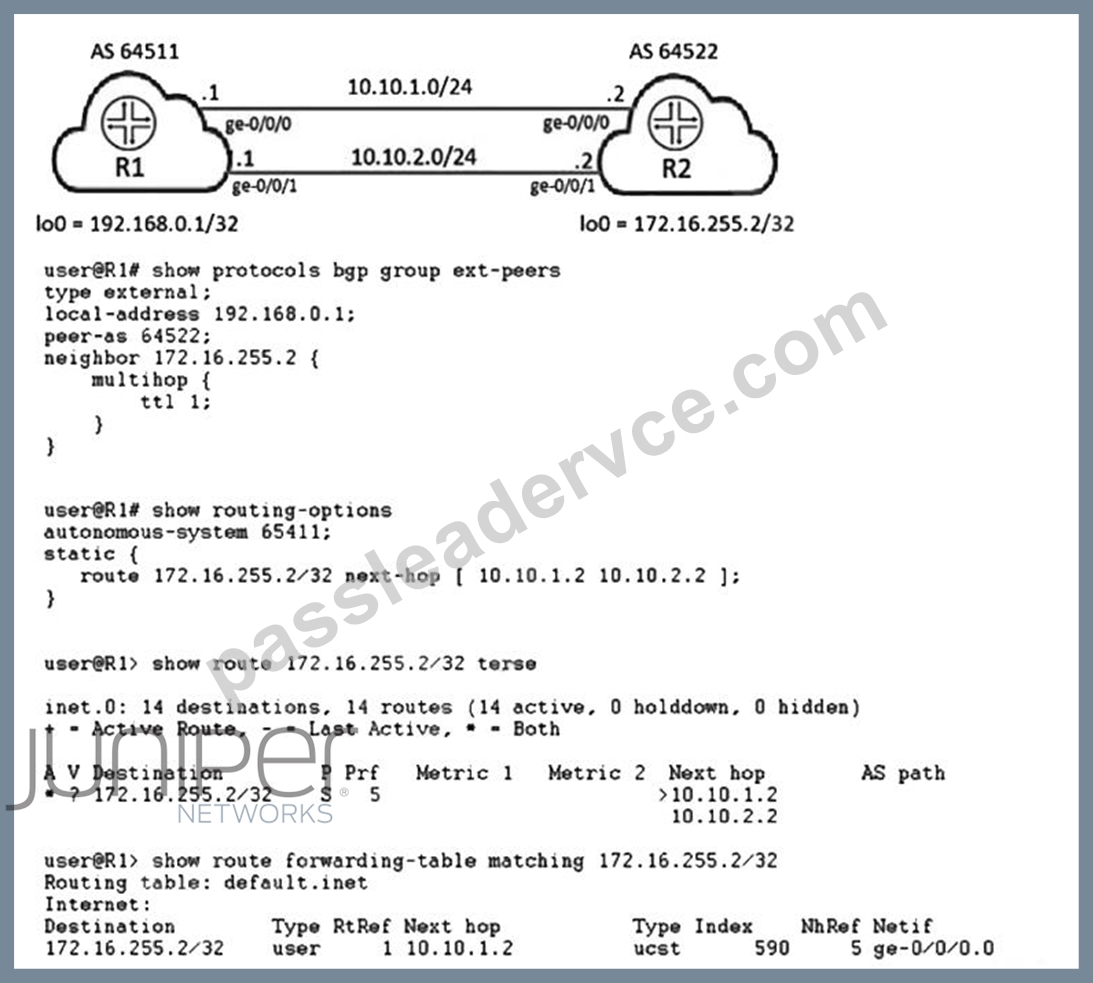
- A. A routing policy will be required to forward traffic to both next hops.
- B. Both the next hops will be used to forward traffic to R2.
- C. The TTL value of 1 is set to limit the scope of the EBGP session.
- D. The ttl statement must be configured to accommodate peering to a loopback address of a directly connected peer.
Answer: A,C
Explanation:
B - because only one next hop in forwarding table C- becuse TTL=1 limiting bgp connection to be established only over loopbacks interface
https://www.juniper.net/documentation/us/en/software/junos/bgp/topics/topic-map/multihop-sessions.html Use the multihop statement to alter the default use of the neighbor's physical address. In addition, you can also specify a time-to-live (TTL) value in the BGP packets to control how far they propagate. We use a TTL value of 1 to ensure that the session cannot be established across any other backdoor links in the network.
NEW QUESTION # 73
Referring to the exhibit, ServerA sends a single IP packet destined to 10.0.0.127. Which two statements correctly describe the behavior of the resulting outbound VXLAN packets that contain the original packet destined to 10.0.0.127? (Choose two.)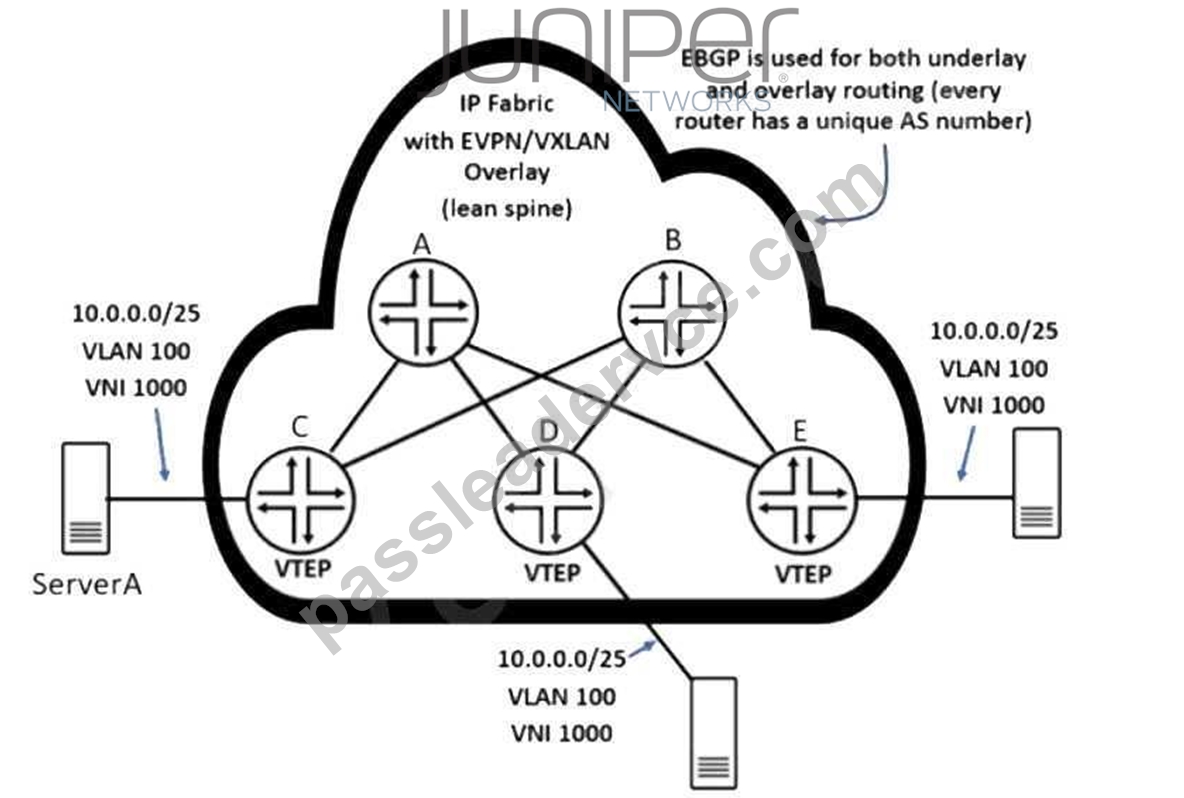
- A. Router D will not replicate and send a copy of the received VXLAN packet to router E.
- B. Router E will replicate and send a copy of the received VXLAN packet to router D.
- C. Router C will send a single VXLAN packet to one remote VTEP.
- D. Router C will send a VXLAN packet destined only to router D and router E.
Answer: B,C
NEW QUESTION # 74
You are asked to deploy 802.1X on your EX Series switches. You need to ensure authenticated devices continue to have access to the network even if the authentication server fails.
Which action meets this configuration objective?
- A. Configure the static MAC bypass for the authentication server.
- B. Set the reauthentication interval to a value of disable.
- C. Configure the server fail fallback with a value of sustain.
- D. Set the reauthentication interval to a value of 0.
Answer: C
Explanation:
https://www.juniper.net/documentation/us/en/software/junos/user-access/topics/concept/802-1x- pnac-divert-authentication-understanding-mx-series.html
NEW QUESTION # 75
You want to provide Layer 2 connectivity between campus sites using Ethernet switches through a metro Ethernet service provider who is using Q-in-Q tagging on their network.
Referring to the exhibit, what are two design considerations in this environment? (Choose two.)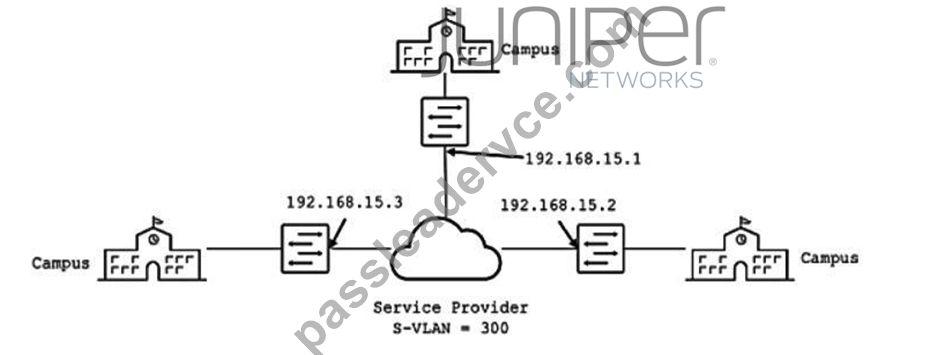
- A. Each campus switch shown must have a C-Tag 300 configured.
- B. L2PT is required on the SP network to support the spanning tree protocol.
- C. Each campus switch shown must have S-Tag 300 configured.
- D. VXLAN could be implemented on your network across this service provider network.
Answer: A,B
Explanation:
VXLAN , L2PT and S-Tag(service VLAN) are handled by ISP.
C-Tag (customer VLAN) is handled by customer. In fact, in customer view, 2 campus switches are direct connected to each others so that they have to configure same vlan info whatever it is trunk or access port.
NEW QUESTION # 76
Your Net is learning the 210.210.40.0/24 route from Provider A and Provider B YourNet would like to forward traffic destined to the 210.210.40.0/24 networking using Provider B.
Referring to the exhibit, how would you accomplish this task?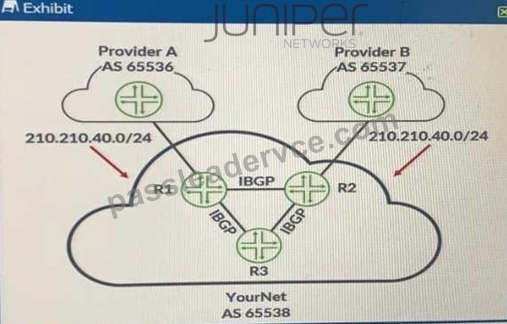
- A. Apply an export policy to R1's IBGP peers to set a higher local preference.
- B. Add the well-known no-export community to the routes learned through R2.
- C. Apply an export policy to R2's IBGP peers to set a Their local preference.
- D. Add the well-known no-export community to the routes learned through R1.
Answer: C
NEW QUESTION # 77
Your IS-IS adjacency is not established as shown in the exhibit. What is the problem?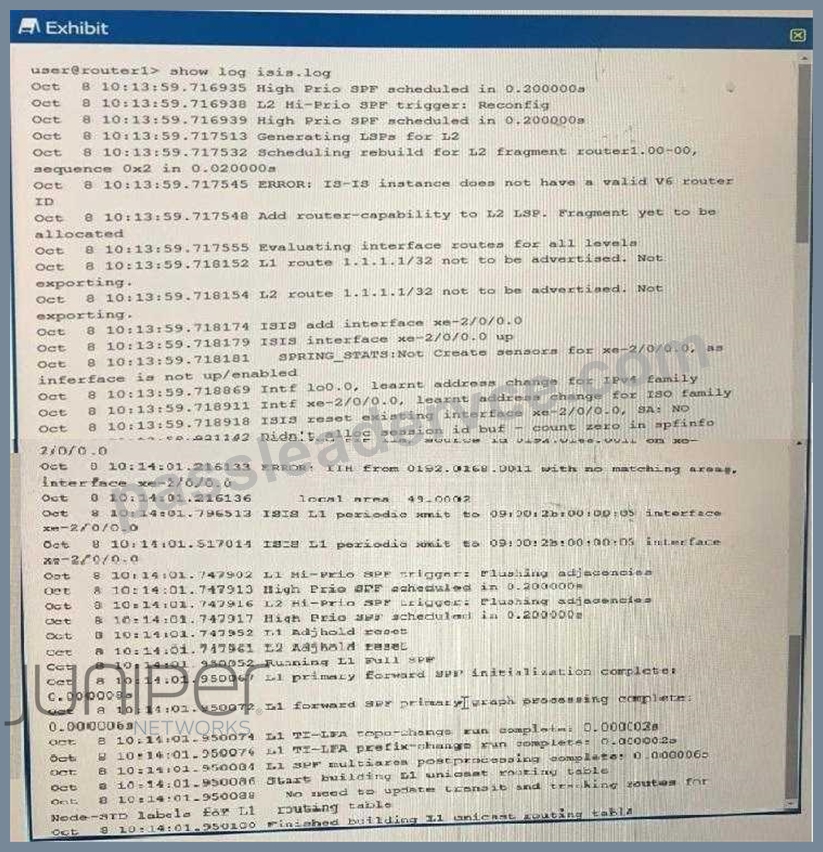
- A. There is an MTU mismatch
- B. There is an invalid IPv4 router ID
- C. There is an invalid IPv6 router ID
- D. There is an area mismatch
Answer: D
NEW QUESTION # 78
Which two statements are correct about the deployment of EVPN-VXLAN on QFX Series devices? (Choose two.)
- A. Type 1 route advertisements always have the single-active flag set to 0.
- B. Junos OS supports underlay replication for BUM traffic forwarding.
- C. Type 1 route advertisements always have the single-active flag set to 1.
- D. Junos OS supports ingress replication for BUM traffic forwarding.
Answer: A,D
Explanation:
BUM Traffic Forwarding
Junos devices that use MPLS encapsulation for EVPNs can only use ingress replication at this time.
Ingress replication means, to flood traffic to remote PE routers, the traffic has to be replicated, once for each remote PE router.
The EVPN label for this BUM traffic is learned per PE router from the route type 3, inclusive multicast Ethernet tag route.
This table shows the format of the inclusive multicast Ethernet tag route.
All-Active Redundancy (4)
This diagram shows the format of the type 1 route, A-D route per ES. The split horizon label is advertised as part of an extended community attached to the type 1 route. The split horizon label is also called the ESI label. The extended community also indicates what type of redundancy mode is used for this given ESI: single-active represented by binary 1 or active-active represented by binary 0.
NEW QUESTION # 79
Which two statements are true regarding BGP load balancing? (Choose two.)
- A. Multipath provides per-prefix load balancing.
- B. Multipath places a single next-hop in the forwarding table for each destination.
- C. Multipath provides per-flow load balancing.
- D. Multipath places multiple next-hops in the forwarding table for each destination.
Answer: A,D
NEW QUESTION # 80
You have configured CoS on a Junos device. A packet is classified as best effort by a behavior aggregate (BA) classifier, and as expedited forwarding by a multifield (MF) classifier.
Which statement is true in this scenario?
- A. The packet will be placed in a queue associated with the BA classifier.
- B. The packet will be placed into the queue which is least congested.
- C. The packet will be placed into the queue that has the most bandwidth assigned to it.
- D. The packet will be placed in a queue associated with the MF classifier.
Answer: D
Explanation:
https://www.juniper.net/documentation/en_US/junos/topics/task/configuration/cos-configuring- multifield-classifiers.html
>> "If you configure both a behavior aggregate (BA) classifier and a multifield classifier, BA classification is performed first; then multifield classification is performed. If they conflict, any BA classification result is overridden by the multifield classifier."
NEW QUESTION # 81
You want to implement an RP in your PIM sparse mode environment, you are considering the advantages and disadvantages of the various RP election methods.
In this scenario, which three implementation guidelines are correct? (Choose three.)
- A. When multiple election methods are implemented on a device, the static method is preferred.
- B. The auto-RP method requires using two PIM dense mode groups from the 323/8 range.
- C. The static method requires configuration on all devices in the PIM domain.
- D. The auto-RP method includes the ability to maintain a backup RP.
- E. With the bootstrap method, the primary criterion for electing a BSR is priority value.
Answer: B,D,E
NEW QUESTION # 82
BGP multipath or multihop are not configured in your network.
In this scenario, what is the correct sequence for BGP active route selection?
- A. higher local preference
shortest AS path
lowest peer address
lowest router ID
lower origin code - B. higher local preference
shortest AS path
lower origin code
lowest router ID
lowest peer address - C. higher local preference
shortest AS path
lowest router ID
lowest peer address
lower origin code - D. higher local preference
lowest router ID
lowest peer address
lower origin code
shortest AS path
Answer: B
Explanation:
The correct sequence for BGP active route selection when BGP multipath or multihop are not configured is as follows:
* Higher local preference: Routes with a higher local preference are preferred.
* Shortest AS path: Routes with the shortest AS path are preferred.
* Lower origin code: Routes with lower origin code (IGP < EGP < Incomplete) are preferred.
* Lowest router ID: Routes with the lowest router ID are preferred.
* Lowest peer address: Routes with the lowest peer address are preferred.
References:
* Standard BGP route selection criteria as outlined in network routing protocols.
* Documentation from "Useful Juniper Commands.txt" and "Juniper Commands.pdf" which include detailed BGP operational commands and preferences.
NEW QUESTION # 83
Your network has an unmanaged switch between the hosts and your EX Series switch. After the traffic enters the EX Series switch, each host must be on a separate VLAN.
How would you accomplish this task?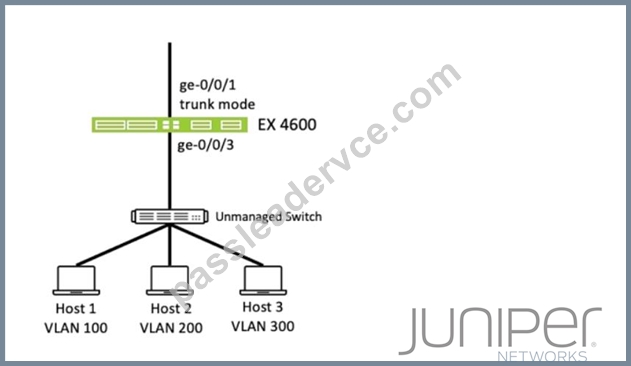
- A. Configure an output firewall filter on interface ge-0/0/1 to match the destination MAC or IP address of the hosts to assign the VLANs.
- B. Configure interface ge-0/0/3 to a mode trunk to assign the VLANs.
- C. Configure an input firewall filter on interface ge-0/0/3 to match the source MAC or IP address of the hosts to assign the VLANs.
- D. Configure VSTP on interface ge-0/0/1 to assign the VLANs.
Answer: C
Explanation:
EX switches has VLAN action on ingress interfaces to forward traffic to specific VLAN.
https://www.juniper.net/documentation/us/en/software/junos/routing-policy/topics/topic- map/firewall-filter-match-condtions-and-actions-qfx.html vlan VLAN-name Forward matched packets to a specific VLAN.
NOTE: The vlan action is supported on ingress interfaces only.
NEW QUESTION # 84
Your enterprise network is running BGP VPNs to support multitenancy. Some of the devices with which you peer BGP do not support the VPN NLRI. You must ensure that you do not send BGP VPN routes to the remote peer.
Which two configuration steps will satisfy this requirement? (Choose two.)
- A. Configure an import policy on the remote peer to reject the routes when they are received.
- B. Configure an export policy on the local BGP peer to reject the VPN routes being sent to the remote peer.
- C. Configure a route reflector for the VPN NLRI.
- D. Configure the apply-vpn-export feature on the local BGP peer.
Answer: B,D
Explanation:
Apply both the VRF export and BGP group or neighbor export policies (VRF first, then BGP) before routes from the vrf or l2vpn routing tables are advertised to other PE routers.
https://www.juniper.net/documentation/us/en/software/junos/bgp/topics/ref/statement/vpn-apply-export-edit-protocols-bgp-vp.html
NEW QUESTION # 85
Referring to the exhibit, how will router E quickly learn that the remote MAC addresses are no longer reachable through the router attached to the failed link?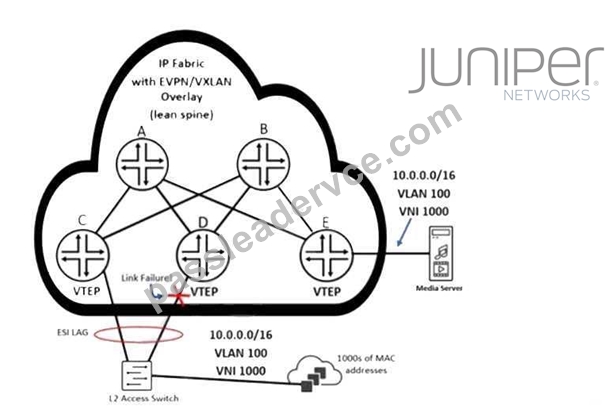
- A. Router E receives Type 1 withdrawal messages from router C.
- B. Router E receives Type 2 withdrawal messages from router C.
- C. Router E receives Type 2 withdrawal messages from router D.
- D. Router E receives Type 1 withdrawal messages from router D.
Answer: D
NEW QUESTION # 86
Referring to the exhibit, traffic ingresses on interface ge-0/0/3 and egresses on interface ge-0/0/4.
Which queue does traffic with the IP precedence value of 100 use?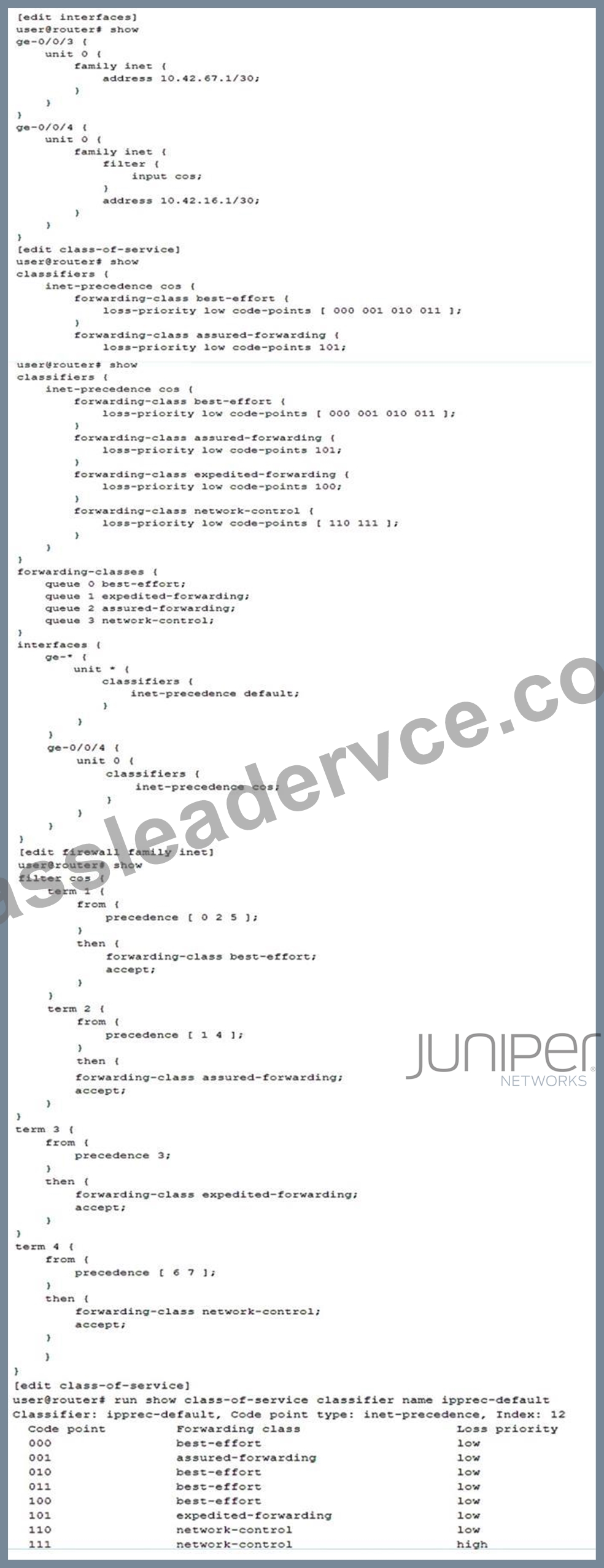
- A. network-control
- B. assured-forwarding
- C. best-effort
- D. expedited-forwarding
Answer: B
NEW QUESTION # 87
......
Updated Exam JN0-649 Dumps with New Questions: https://www.passleadervce.com/JNCIP-ENT/reliable-JN0-649-exam-learning-guide.html
Dumps to Pass your JN0-649 Exam with 100% Real Questions and Answers: https://drive.google.com/open?id=1UZKof2P4Uq-Yr8qun6Idl1We3UYXxhg9