

Prepare AZ-104 Question Answers - AZ-104 Exam Dumps
Real Microsoft AZ-104 Exam Questions [Updated 2025]
NEW QUESTION # 45
You have an Azure subscription that contains a virtual network named VNET1 in the East US 2 region. You have the following resources in an Azure Resource Manager template.


For each of the following statements, select Yes if the statement is true. Otherwise, select No.
Answer:
Explanation:
Reference:
https://docs.microsoft.com/en-us/azure/architecture/resiliency/recovery-loss-azure-region
NEW QUESTION # 46
You have an Azure Active Directory (Azure AD) tenant named adatum.com. Adatum.com contains the groups in the following table.
You create two user accounts that are configured as shown in the following table.
To which groups do User1 and User2 belong? To answer. select the appropriate options in the answer area.
NOTE: Each correct selection is worth one point.
Answer:
Explanation:
NEW QUESTION # 47
You have an Azure subscription that contains the resources shown in the following table:
You assign a policy to RG6 as shown in the following table:
To RG6, you apply the tag: RGroup: RG6.
You deploy a virtual network named VNET2 to RG6.
Which tags apply to VNET1 and VNET2? To answer, select the appropriate options in the answer area.
NOTE: Each correct selection is worth one point.
Answer:
Explanation:
Reference:
https://docs.microsoft.com/en-us/azure/azure-resource-manager/management/tag-policies
NEW QUESTION # 48
You need to create an Azure Storage account that meets the following requirements:
* Minimizes costs
* Supports hot, cool, and archive blob tiers
* Provides fault tolerance if a disaster affects the Azure region where the account resides
How should you complete the command? To answer, select the appropriate options in the answer area. NOTE: Each correct selection is worth one point
Answer:
Explanation:
Explanation:
Box 1: StorageV2
You may only tier your object storage data to hot, cool, or archive in Blob storage and General Purpose v2 (GPv2) accounts. General Purpose v1 (GPv1) accounts do not support tiering.
General-purpose v2 accounts deliver the lowest per-gigabyte capacity prices for Azure Storage, as well as industry-competitive transaction prices.
Box 2: Standard_GRS
Geo-redundant storage (GRS): Cross-regional replication to protect against region-wide unavailability.
Incorrect Answers:
Locally-redundant storage (LRS): A simple, low-cost replication strategy. Data is replicated within a single storage scale unit.
Read-access geo-redundant storage (RA-GRS): Cross-regional replication with read access to the replica. RA-GRS provides read-only access to the data in the secondary location, in addition to geo-replication across two regions, but is more expensive compared to GRS.
References:
https://docs.microsoft.com/en-us/azure/storage/common/storage-redundancy-grs
https://docs.microsoft.com/en-us/azure/storage/blobs/storage-blob-storage-tiers
NEW QUESTION # 49
You have an Azure subscription named Sub1 that contains the blob containers shown in the following table.
Sub1 contains two users named User1 and User2. Both users are assigned the Reader role at the Sub1 scope.
You have a condition named Condition1 as shown in the following exhibit.
You assign roles to User1 and User2 as shown in the following table.
For each of the following statements, select Yes if the statement is true. Otherwise, select No. NOTE: Each correct selection is worth one point.
Answer:
Explanation:
Explanation:
NEW QUESTION # 50
You are creating an Azure load balancer.
You need to add an IPv6 load balancing rule to the load balancer.
How should you complete the Azure PowerShell script? To answer, select the appropriate options in the answer area.
NOTE: Each correct selection is worth one point.
Answer:
Explanation:
Reference:
https://docs.microsoft.com/en-us/azure/load-balancer/load-balancer-ipv6-internet-ps
NEW QUESTION # 51
You have an Azure virtual machine that runs Windows Server 2019 and has the following configurations:
Name: VM1
Location: West US
Connected to: VNET1
Private IP address: 10.1.0.4
Public IP address: 52.186.85.63
DNS suffix in Windows Server: Adatum.com
You create the Azure DNS zones shown in the following table.
You need to identify which DNS zones you can link to VNET1 and the DNS zones to which VM1 can automatically register.
Which zones should you identify? To answer, select the appropriate options in the answer area.
Answer:
Explanation:
Reference:
https://docs.microsoft.com/en-us/azure/dns/private-dns-overview
NEW QUESTION # 52
You are configuring serverless computing in Azure.
You need to receive an email message whenever a resource is created in or deleted from a resource group. Which three actions should you perform in sequence? To answer, move the appropriate actions from the list of actions to the answer area and arrange them in the correct order.
Answer:
Explanation:
Reference:
https://docs.microsoft.com/en-us/azure/event-grid/monitor-virtual-machine-changes-event-grid-logic-app
NEW QUESTION # 53
You have an Azure subscription that contains the resource groups shown in the following table.
RG1 contains the resources shown in the following table.
RG2 contains the resources shown in the following table.
You need to identify which resources you can move from RG1 to RG2, and which resources you can move from RG2 to RG1.
Which resources should you identify? To answer, select the appropriate options in the answer area.
Answer:
Explanation:
Reference:
https://docs.microsoft.com/en-us/azure/governance/blueprints/concepts/resource-locking
NEW QUESTION # 54
Note: This question is part of a series of questions that present the same scenario. Each question in the series contains a unique solution that might meet the stated goals. Some question sets might have more than one correct solution, while others might not have a correct solution.
After you answer a question in this section, you will NOT be able to return to it. As a result, these questions will not appear in the review screen.
You have an Azure subscription that contains 10 virtual networks. The virtual networks are hosted in separate resource groups.
Another administrator plans to create several network security groups (NSGs) in the subscription.
You need to ensure that when an NSG is created, it automatically blocks TCP port 8080 between the virtual networks.
Solution: You configure a custom policy definition, and then you assign the policy to the subscription.
Does this meet the goal?
- A. No
- B. Yes
Answer: B
Explanation:
Resource policy definition used by Azure Policy enables you to establish conventions for resources in your organization by describing when the policy is enforced and what effect to take. By defining conventions, you can control costs and more easily manage your resources.
References: https://docs.microsoft.com/en-us/azure/azure-policy/policy-definition
NEW QUESTION # 55
You have an Azure virtual machine that runs Windows Server 2019 and has the following configurations:
* Name: VM1
* Location: West US
* Connected to: VNET1
* Private IP address: 10.1.0.4
* Public IP addresses: 52.186.85.63
* DNS suffix in Windows Server: Adatum.com
You create the Azure DNS zones shown in the following table.
You need to identify which DNS zones you can link to VNET1 and the DNS zones to which VM1 can automatically register.
Which zones should you identify? To answer, select the appropriate options in the answer area.
NOTE: Each correct selection is worth one point.
Answer:
Explanation:
Explanation
Reference:
https://docs.microsoft.com/en-us/azure/dns/private-dns-overview
NEW QUESTION # 56
You have 100 Azure subscriptions. All the subscriptions are associated to the same Azure Active Directory (Azure AD) tenant named contoso.com.
You are a global administrator.
You plan to create a report that lists all the resources across all the subscriptions.
You need to ensure that you can view all the resources in all the subscriptions.
What should you do?
- A. From the Azure portal, modify the properties of the Azure AD tenant.
- B. From Windows PowerShell, run the New-AzureADUserAppRoleAssignment cmdlet.
- C. From the Azure portal, modify the profile settings of your account.
- D. From Windows PowerShell, run the Add-AzureADAdministrativeUnitMember cmdlet.
Answer: B
Explanation:
Explanation
The New-AzureADUserAppRoleAssignment cmdlet assigns a user to an application role in Azure Active Directory (AD). Use it for the application report.
References:
https://docs.microsoft.com/en-us/powershell/module/azuread/new-azureaduserapproleassignment?view=azuread
NEW QUESTION # 57
Hotspot Question
You have an Azure Active Directory (Azure AD) tenant.
You need to create a conditional access policy that requires all users to use multi-factor authentication when they access the Azure portal.
Which three settings should you configure? To answer, select the appropriate settings in the answer area.
NOTE: Each correct selection is worth one point.
Answer:
Explanation:
Explanation:
- Select Users & Groups : Where you have to choose all users.
- Select Cloud apps or actions: to specify the Azure portal
- Grant: to grant the MFA.
Those are the minimum requirements to create MFA policy. No conditions are required in the question.
https://docs.microsoft.com/en-us/azure/active-directory/conditional-access/concept-conditional- access-policies
NEW QUESTION # 58
You plan to use the Azure Import/Export service to copy files to a storage account.
Which two files should you create before you prepare the drives for the import job? Each correct answer presents part of the solution.
NOTE: Each correct selection is worth one point.
- A. a driveset CSV file
- B. a JSON configuration file
- C. a PowerShell PS1 file
- D. an XML manifest file
- E. a dataset CSV file
Answer: A,E
Explanation:
B: Modify the driveset.csv file in the root folder where the tool resides.
C: Modify the dataset.csv file in the root folder where the tool resides. Depending on whether you want to import a file or folder or both, add entries in the dataset.csv file References:
https://docs.microsoft.com/en-us/azure/storage/common/storage-import-export-data-to-files
NEW QUESTION # 59
You have an Azure subscription that uses the public IP addresses shown in the following table.
You need to create a public Azure Standard Load Balancer.
Which public IP addresses can you use?
- A. IP1 and IP3 only
- B. IP1, IP2, and IP3
- C. IP2 only
- D. IP3 only
Answer: D
Explanation:
Matching SKUs are required for load balancer and public IP resources. You can't have a mixture of Basic SKU resources and standard SKU resources.
Reference:
https://docs.microsoft.com/en-us/azure/virtual-network/ip-services/public-ip-addresses
NEW QUESTION # 60
You have an Azure subscription that contains the storage accounts shown in the following table.
You need to identify which storage account can be converted to zone-redundant storage (ZRS) replication by requesting a live migration from Azure support.
What should you identify?
- A. Storage4
- B. Storage3
- C. Storage2
- D. Storage1
Answer: C
Explanation:
ZRS currently supports standard general-purpose v2, FileStorage and BlockBlobStorage storage account types.
Incorrect Answers:
A, not C: Live migration is supported only for storage accounts that use LRS replication. If your account uses GRS or RA-GRS, then you need to first change your account's replication type to LRS before proceeding. This intermediary step removes the secondary endpoint provided by GRS/RA-GRS.
Also, only standard storage account types support live migration. Premium storage accounts must be migrated manually.
D: ZRS currently supports standard general-purpose v2, FileStorage and BlockBlobStorage storage account types.
Reference:
https://docs.microsoft.com/en-us/azure/storage/common/storage-redundancy-zrs
https://docs.microsoft.com/en-us/azure/storage/common/storage-redundancy
NEW QUESTION # 61
You have an Azure subscription that contains the storage accounts shown in the following table.
Which storage account can be converted to zone-redundant storage (ZRS) replication?
- A. storage3
- B. storage1
- C. storage4
- D. storage2
Answer: D
Explanation:
To convert to ZRS must the Kind be: Standard general-purpose v2 (StorageV2), Premium block blobs (BlockBlobStorage) or Premium file shares (FileStorage) and the Replication is from LRS possible (...from GRS/RA-GRS convert to LRS first)
https://learn.microsoft.com/en-us/azure/storage/common/storage-redundancy#supported-storage- account-types
https://learn.microsoft.com/en-us/azure/storage/common/redundancy-
migration?tabs=portal#replication-change-table
NEW QUESTION # 62
You sign up for Azure Active Directory (Azure AD) Premium.
You need to add a user named [email protected] as an administrator on all the computers that will be joined to the Azure AD domain.
What should you configure in Azure AD?
- A. User settings from the Users blade.
- B. Device settings from the Devices blade.
- C. Providers from the MFA Server blade.
- D. General settings from the Groups blade.
Answer: B
Explanation:
When you connect a Windows device with Azure AD using an Azure AD join, Azure AD adds the following security principles to the local administrators group on the device:
The Azure AD global administrator role
The Azure AD device administrator role
The user performing the Azure AD join
In the Azure portal, you can manage the device administrator role on the Devices page. To open the Devices page:
1. Sign in to your Azure portal as a global administrator or device administrator.
2. On the left navbar, click Azure Active Directory.
3. In the Manage section, click Devices.
4. On the Devices page, click Device settings.
5. To modify the device administrator role, configure Additional local administrators on Azure AD joined devices.
NEW QUESTION # 63
You have an Azure subscription that contains a virtual network named VNET1 in the East US 2 region. You have the following resources in an Azure Resource Manager template.


For each of the following statements, select Yes if the statement is true. Otherwise, select No.
Answer:
Explanation:
Explanation
Box 1: Yes
Box 2: Yes
VM1 is in Zone1, while VM2 is on Zone2.
Box 3: No
Reference:
https://docs.microsoft.com/en-us/azure/architecture/resiliency/recovery-loss-azure-region
NEW QUESTION # 64
You have an Azure virtual machine that runs Windows Server 2019 and has the following configurations:
Name: VM1
Location: West US
Connected to: VNET1
Private IP address: 10.1.0.4
Public IP addresses: 52.186.85.63
DNS suffix in Windows Server: Adatum.com
You create the Azure DNS zones shown in the following table.
You need to identify which DNS zones you can link to VNET1 and the DNS zones to which VM1 can automatically register.
Which zones should you identify? To answer, select the appropriate options in the answer area.
NOTE: Each correct selection is worth one point.
Answer:
Explanation:
Reference:
https://docs.microsoft.com/en-us/azure/dns/private-dns-overview
NEW QUESTION # 65
You have an Azure Active Directory (Azure AD) tenant named Tenant1 and an Azure subscription named You enable Azure AD Privileged Identity Management.
You need to secure the members of the Lab Creator role. The solution must ensure that the lab creators request access when they create labs.
What should you do first?
- A. From Azure AD Identity Protection, creates a user risk policy.
- B. From Azure AD Privileged Identity Management, discover the Azure resources of Conscription.
- C. From Subscription1 edit the members of the Lab Creator role.
- D. From Azure AD Privileged Identity Management, edit the role settings for Lab Creator.
Answer: D
Explanation:
As a Privileged Role Administrator you can:
Enable approval for specific roles
Specify approver users and/or groups to approve requests
View request and approval history for all privileged roles
Reference:
https://docs.microsoft.com/en-us/azure/active-directory/privileged-identity-management/pim-configure
NEW QUESTION # 66
You have an Azure subscription that has the Azure container registries shown in the following table.
You plan to use ACR Tasks and configure endpoint connections.
Answer:
Explanation:
NEW QUESTION # 67
You have an Azure subscription that contains a virtual network named VNET1 in the East US 2 region. You have the following resources in an Azure Resource Manager template.


For each of the following statements, select Yes if the statement is true. Otherwise, select No.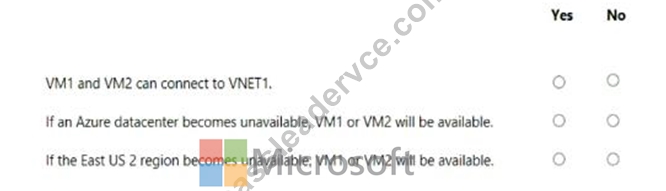
Answer:
Explanation:
Reference:
https://docs.microsoft.com/en-us/azure/architecture/resiliency/recovery-loss-azure-region
NEW QUESTION # 68
You need to use Azure Automation State Configuration to manage the ongoing consistency of virtual machine configurations.
Which five actions should you perform in sequence? To answer, move the appropriate action from the list of actions to the answer area and arrange them in the correct order.
NOTE: More than one order of answer choices is correct. You will receive credit for any of the correct orders you select.
Answer:
Explanation:
Reference:
https://docs.microsoft.com/en-us/azure/automation/automation-dsc-getting-started
NEW QUESTION # 69
You have an Azure subscription that contains an Azure Storage account.
You plan to copy an on-premises virtual machine image to a container named vmimages.
You need to create the container for the planned image.
Which command should you run? To answer, select the appropriate options in the answer area.
NOTE: Each correct selection is worth one point.
Answer:
Explanation:
Reference:
https://adamtheautomator.com/azcopy-copy-files/
NEW QUESTION # 70
......
AZ-104 Exam Dumps Pass with Updated 2025: https://www.passleadervce.com/Microsoft-Azure-Administrator-Associate/reliable-AZ-104-exam-learning-guide.html
Free AZ-104 Exam Dumps to Pass Exam Easily: https://drive.google.com/open?id=1fyhVSCQ8jEbT_-2XGAyU-ytk-KhCnybl