

Use ACD101 Exam Dumps (2024 PDF Dumps) To Have Reliable ACD101 Test Engine
ACD101 PDF Recently Updated Questions Dumps to Improve Exam Score
NEW QUESTION # 22
You are running a process instance and an error occurs on an unattended node.
What happens to your process when this error occurs?
- A. * The process is paused.
* Parallel paths in the process are stopped.
* An alert Is sent to the process initiator.
* These nodes are included in the num_problem_tasks process metric in process reports. - B. * The process is paused.
* Parallel paths in the process are stopped.
* No alerts are sent.
* These nodes are included in the num_problem_tasks process metric in process reports. - C. * The process is not paused.
* Parallel paths in the process continue to proceed.
* An alert is sent to the appropriate recipients (usually admins).
* These nodes are not included in the num_problem_tasks process metric in process reports.
Answer: C
Explanation:
When an error occurs on an unattended node in a running process instance:
The process is not paused, allowing other parallel paths to continue.
An alert is typically sent to appropriate recipients, such as administrators, to notify them of the issue.
These nodes are not counted in the num_problem_tasks process metric, which is used in process reports to track problematic tasks.
This behavior ensures that the rest of the process can continue as intended while alerting administrators to intervene and address the error.
Reference:
Appian Documentation: Error Handling in Processes
NEW QUESTION # 23
What is an Appian best practice for calling interface rules on your interface?
- A. Call the interface rule on a rule input.
- B. Always use consistent ordering of rule parameters.
- C. Use keyword syntax.
Answer: B
Explanation:
An Appian best practice for calling interface rules within your interfaces is to always use a consistent ordering of rule parameters. This practice enhances the readability and maintainability of your interfaces, ensuring that other developers can understand and modify the interface more easily.
Reference:
Appian Documentation: Designing Interfaces
NEW QUESTION # 24
You are creating a new customer onboarding application. Documents are required from customers for verification and onboarding purposes. You need to store these documents within Appian.
Which two areas in Appian should you configure? (Choose two.)
- A. Knowledge Center
- B. Folder
- C. Feed
- D. Decision Object
Answer: A,B
Explanation:
In Appian, to store documents such as those required for customer onboarding, you should configure a Knowledge Center and within that, Folders. The Knowledge Center in Appian serves as the top-level container for storing and organizing documents and folders. Folders within a Knowledge Center provide a way to categorize and manage access to documents, making them an essential part of document management in Appian applications. Decision Objects and Feeds are not related to document storage.
Reference: Appian Documentation - Knowledge Centers and Folders
NEW QUESTION # 25
When applying a default filter to a record type, what is a true statement for excluded data?
- A. The data does not show up in the record list, but can be accessed by end-users using a direct link to a record view.
- B. The data does not show up in the record list. End-users are unable to clear the filter condition to view the data.
- C. The data does not show up in the record list, but end-users can clear the filter condition to view the data.
Answer: C
Explanation:
When a default filter is applied to a record type in Appian, the data excluded by that filter does not appear in the default record list. However, end-users with appropriate permissions can modify or clear the filter conditions to view the excluded data. This behavior allows for a flexible and user-driven data exploration experience within Appian record lists.
Reference: Appian Documentation - Record Lists and Filters
NEW QUESTION # 26
Review the following variables:
Match each expression rule to the expected output.
Note: Each output will be used once or not at all. To change your responses, you may deselect your response by clicking the blank space at the top of the selection list.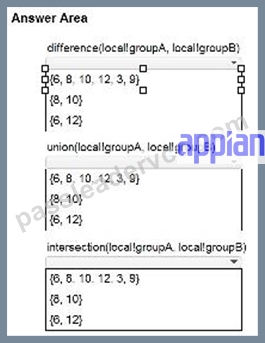
Answer:
Explanation:
Reference:
Appian Documentation: Functions (difference, union, intersection)
NEW QUESTION # 27
You received a support ticket where the user claims that nothing happens when they click the button to complete a task. You confirm that the user is assigned to the task.
What is a possible reason for this problem?
- A. The button was not configured to submit the form.
- B. The process report that drives the runtime database does not have security set properly.
- C. The user was not in the user group configured for the process model security.
Answer: A
Explanation:
If a user claims that nothing happens when they click a button to complete a task, a possible reason could be that the button was not configured to submit the form. This configuration is essential for triggering the form submission action, which in turn can complete the task or initiate further processes. Without this setup, clicking the button will not result in any action.
Reference:
Appian Documentation: Configuring Buttons in Interfaces
NEW QUESTION # 28
You are configuring an employee onboarding User Input Task that will be assigned to the human resources group.
Based on the default behavior for task assignments, which statement is valid?
- A. One user in the group can accept the task for themselves and complete it.
- B. Multiple users can accept the task at the same time up until the point that the first user completes it.
- C. For each user in the group, a task is generated and assigned to them to complete.
Answer: A
Explanation:
Based on the default behavior for task assignments in Appian, when a User Input Task is assigned to a group, any one member of the group can accept the task. Once accepted, the task becomes locked to that user, and they are responsible for completing it. This prevents multiple users from working on the same task simultaneously and ensures clear accountability.
Reference: Appian Documentation - Task Assignments and User Input Tasks
NEW QUESTION # 29
You are creating a form used to order a pizz
a. You use a radio button component for the selection.
The pizza selection labels include a list of toppings. You do not want the selection labels to be truncated.
Which layout should you choose?
- A. Grid
- B. Stacked
- C. Compact
Answer: B
Explanation:
For a pizza ordering form where you do not want the radio button selection labels to be truncated, the Stacked layout is the most appropriate. This layout will list the options vertically, giving each one adequate space and preventing truncation, which is particularly useful when the labels include longer text, such as a list of toppings.
Reference: Appian Documentation - Interface Components
NEW QUESTION # 30
Which step can be critical in passing information from a form back to a process model?
- A. Configure the Data Management tab.
- B. Configure inputs on the Data tab of a User Input Task.
- C. Configure the activity class parameters of a Write to Data Store Entity node, a
Answer: B
Explanation:
The critical step in passing information from a form back to a process model is to configure inputs on the Data tab of a User Input Task. When you create a User Input Task, it includes a form for users to interact with. The data entered into this form can be mapped to process variables via the Data tab configuration. This ensures that the information collected in the form is available to the process for further use.
Reference: Appian Documentation - User Input Tasks
NEW QUESTION # 31
Which Appian feature can help the implementation team analyze the event log data of an existing process?
- A. RPA
- B. Process Mining
- C. Workflow
Answer: B
Explanation:
vent logs. It uses the data from process models to give insights into process performance, bottlenecks, and compliance with the designed process flow. This feature is valuable for understanding the actual performance of business processes and for identifying areas for improvement.
Reference: Appian Documentation - Process Mining
NEW QUESTION # 32
You are developing an expression rule. You need to find information on employing an Appian function that you have not used before.
For more information on the Appian function, what should you do first?
- A. Post a question on Appian Community.
- B. Search the Appian Knowledge Base Articles.
- C. Look up the function in the Appian Documentation.
Answer: C
Explanation:
When you need information on using a specific Appian function that you have not used before, the first step should be to consult the Appian Documentation. The documentation provides comprehensive details on each function, including syntax, parameters, usage examples, and best practices, which is essential for understanding how to correctly employ the function in an expression.
Reference: Appian Documentation - Functions
NEW QUESTION # 33
ACME Automobile uses Appian to manage their vehicle fleet. Vehicle records can have a status of either "active" or "inactive".
Users are primarily concerned with active vehicles and want to see only those records by default when viewing the Vehicle records list. However, it is important for users to be able to see the unfiltered list of Vehicle records on demand to address occasional auditing requests from managers.
Which configuration supports the desired Vehicle record list behavior?
- A. A user filter for the status field with a default option corresponding to "active".
- B. Visibility on the Status column in the Vehicle record list set with conditional logic.
- C. A source filter set to exclude vehicles with status "inactive".
Answer: A
Explanation:
To achieve the behavior where users see only "active" vehicle records by default but can also view all records when needed, you should configure a user filter for the status field on the Vehicle record list. This user filter should have a default value set to "active", which will filter the list to only show active records initially. However, users will still have the option to adjust the filter to see all records, thus accommodating occasional auditing requests.
Reference: Appian Documentation - Record List Filters and User Filters
NEW QUESTION # 34
You have two record types: ACME_Student and ACME_Class.
You need to add a many-to-many relationship between these two record types.
What should you do?
- A. Create a new record type with data sync enabled, then add a one-to-many relationship from each record type (ACME_Student and ACME_Class) to the new mapping record type.
- B. Add the relationship from either ACME_Student or ACME_Class, then select Many-to-Many under Relationship Type, and add the corresponding keys.
- C. This relationship cannot be modeled using record type relationships.
Answer: A
Explanation:
To establish a many-to-many relationship between two record types in Appian, you should create a junction or mapping record type that will handle the many-to-many association. This new record type should have two one-to-many relationships, one to each of the original record types (ACME_Student and ACME_Class). This setup allows each student to be associated with multiple classes and each class to be associated with multiple students.
Reference: Appian Documentation - Record Type Relationships
NEW QUESTION # 35
What are three ways to trigger a process from a process model? (Choose three.)
- A. Use a!recordActionItem().
- B. Run a!startProcess() from a script task.
- C. Use a Start Process smart service.
- D. Call a web API.
- E. Use a subprocess.
Answer: B,C,E
Explanation:
There are multiple ways to trigger a process from a process model in Appian:
A subprocess is a process model that is called from within another process model.
A Start Process smart service is a flow element that you can use within a process model to start another process.
The a!startProcess() function can be used within a script task to start a process programmatically. These methods allow a developer to initiate a new process instance from an existing process.
Reference: Appian Documentation - Process Model Triggers and Smart Services
NEW QUESTION # 36
Which set of out-of-the-box features is only available when data sync is enabled on a record type?
- A. Define record type relationships
Add custom record fields
Configure record-level security - B. Generate record actions
Define record type object security
Add custom record fields - C. Define record type relationships
Add hidden record fields
Configure record-level security
Answer: C
Explanation:
Data sync enables additional features for record types in Appian. With data sync enabled, you can define relationships between different record types, add fields to a record type that do not appear in the source database (hidden fields), and configure record-level security to control access to individual records based on user roles or other criteria. These features are part of the enhanced functionality provided by data sync to ensure efficient data management and security within Appian applications.
Reference: Appian Documentation - Record Type Features and Data Sync
NEW QUESTION # 37
How can you add test data into your rule inputs while editing an interface object?
- A. Select the Gear icon, select Properties, and set test values.
- B. Select the Test button and set test values.
- C. Select the Performance tab and set test values.
Answer: B
Explanation:
While editing an interface object in Appian, you can add test data into your rule inputs by selecting the Test button. This feature allows you to simulate how the interface would behave with specific inputs, facilitating a more efficient and accurate design and debugging process.
Reference:
Appian Documentation: Testing Interfaces
NEW QUESTION # 38
What is the Production environment used for?
- A. Allowing developers to make updates to the application.
- B. Allowing business users to use the final version of the application.
- C. Allowing business users to test the application.
Answer: B
Explanation:
The Production environment in Appian is used for allowing business users to use the final version of the application. This environment is where fully developed, tested, and approved applications are deployed for end-user interaction. It is the live environment that supports actual business operations, ensuring that users have access to stable and reliable application functionalities for their day-to-day tasks.
Reference:
Appian Documentation: Application Environments
NEW QUESTION # 39
You need to be able to define record type relationships.
What is a required prerequisite in Appian?
- A. The record types must have data sync enabled.
- B. The record types must be on a virtualized data source.
- C. The record types must be stored in the local Appian business database.
Answer: A
Explanation:
To define record type relationships in Appian, it's required that the record types have data sync enabled. This is necessary to ensure that the data is readily available in Appian for the relationships to be established and maintained.
Reference:
Appian Documentation: Record Type Relationships
NEW QUESTION # 40
You are working on a process model "VIM Update Vehicle."
You want to call another process "VIM Get Service Date" that accepts pv!vehicleId as a process parameter and sets a value for pv!serviceDate. The next node in VIM Update Vehicle depends on the value of pv!serviceDate.
Which node should you use to execute "VIM Get Service Date" from VIM Update Vehicle?
- A. Synchronous subprocess with input and output variables configured
- B. Start Process smart service
- C. Asynchronous subprocess with activity chaining
Answer: A
Explanation:
When a process model depends on the value of a variable being set by another process, a synchronous subprocess should be used. This ensures that the calling process (VIM Update Vehicle) will wait for the subprocess (VIM Get Service Date) to complete and set the necessary pv!serviceDate value before continuing. The subprocess node should be configured with input and output variables to pass the pv!vehicleId and receive the pv!serviceDate.
Reference:
Appian Documentation: Subprocess Node
NEW QUESTION # 41
......
ACD101 Dumps Full Questions with Free PDF Questions to Pass: https://www.passleadervce.com/Associate-Developer/reliable-ACD101-exam-learning-guide.html
Free Associate Developer ACD101 Official Cert Guide PDF Download: https://drive.google.com/open?id=1drJAfVn7WeBDegdrYjtqvYePnTtmQlL3