

Valid Microsoft Azure AZ-204 Dumps Ensure Your Passing
AZ-204 Dumps Real Exam Questions Test Engine Dumps Training
NEW QUESTION 126
Contoso, Ltd. provides an API to customers by using Azure API Management (APIM). The API authorizes users with a JWT token.
You must implement response caching for the APIM gateway. The caching mechanism must detect the user ID of the client that accesses data for a given location and cache the response for that user ID.
You need to add the following policies to the policies file:
* a set-variable policy to store the detected user identity
* a cache-lookup-value policy
* a cache-store-value policy
* a find-and-replace policy to update the response body with the user profile information To which policy section should you add the policies? To answer, drag the appropriate sections to the correct policies. Each section may be used once, more than once, or not at all. You may need to drag the split bar between panes or scroll to view content NOTE: Each correct selection is worth one point
Answer:
Explanation:
Box 1: Inbound.
A set-variable policy to store the detected user identity.
Example:
<policies>
<inbound>
<!-- How you determine user identity is application dependent -->
<set-variable
name="enduserid"
value="@(context.Request.Headers.GetValueOrDefault("Authorization","").Split(' ')[1].AsJwt()?.Subject)" /> Box 2: Inbound A cache-lookup-value policy Example:
<inbound>
<base />
<cache-lookup vary-by-developer="true | false" vary-by-developer-groups="true | false" downstream-caching-type="none | private | public" must-revalidate="true | false">
<vary-by-query-parameter>parameter name</vary-by-query-parameter> <!-- optional, can repeated several times -->
</cache-lookup>
</inbound>
Box 3: Outbound
A cache-store-value policy.
Example:
<outbound>
<base />
<cache-store duration="3600" />
</outbound>
Box 4: Outbound
A find-and-replace policy to update the response body with the user profile information.
Example:
<outbound>
<!-- Update response body with user profile-->
<find-and-replace
from='"$userprofile$"'
to="@((string)context.Variables["userprofile"])" />
<base />
</outbound>
Reference:
https://docs.microsoft.com/en-us/azure/api-management/api-management-caching-policies
https://docs.microsoft.com/en-us/azure/api-management/api-management-sample-cache-by-key
NEW QUESTION 127
You plan to create a Docker image that runs as ASP.NET Core application named ContosoApp. You have a setup script named setupScript.ps1 and a series of application files including ContosoApp.dll.
You need to create a Dockerfile document that meets the following requirements:
* Call setupScript.ps1 when the container is built.
* Run ContosoApp.dll when the container starts.
The Docker document must be created in the same folder where ContosoApp.dll and setupScript.ps1 are stored.
Which four commands should you use to develop the solution? To answer, move the appropriate commands from the list of commands to the answer area and arrange them in the correct order.
Answer:
Explanation:
References:
https://docs.microsoft.com/en-us/azure/app-service/containers/tutorial-custom-docker-image
NEW QUESTION 128
You are developing a back-end Azure App Service that scales based on the number of messages contained in a Service Bus queue.
A rule already exists to scale up the App Service when the average queue length of unprocessed and valid queue messages is greater than 1000.
You need to add a new rule that will continuously scale down the App Service as long as the scale up condition is not met.
How should you configure the Scale rule? To answer, select the appropriate options in the answer area.
NOTE: Each correct selection is worth one point.
Answer:
Explanation:
Explanation

Box 1: Service bus queue
You are developing a back-end Azure App Service that scales based on the number of messages contained in a Service Bus queue.
Box 2: ActiveMessage Count
ActiveMessageCount: Messages in the queue or subscription that are in the active state and ready for delivery.
Box 3: Count
Box 4: Less than or equal to
You need to add a new rule that will continuously scale down the App Service as long as the scale up condition is not met.
Box 5: Decrease count by
NEW QUESTION 129
You have a web service that is used to pay for food deliveries. The web service uses Azure Cosmos DB as the data store.
You plan to add a new feature that allows users to set a tip amount. The new feature requires that a property named tip on the document in Cosmos DB must be present and contain a numeric value.
There are many existing websites and mobile apps that use the web service that will not be updated to set the tip property for some time.
How should you complete the trigger?
NOTE: Each correct selection is worth one point.
Answer:
Explanation:
Reference:
https://docs.microsoft.com/bs-latn-ba/azure/cosmos-db/how-to-write-stored-procedures-triggers-udfs
https://mkyong.com/javascript/check-if-variable-is-a-number-in-javascript/
NEW QUESTION 130
You are developing an internal website for employees to view sensitive dat a. The website uses Azure Active Directory (AAD) for authentication. You need to implement multifactor authentication for the website.
What should you do? Each correct answer presents part of the solution.
NOTE; Each correct selection is worth one point.
- A. In Azure AD, enable application proxy.
- B. Upgrade to Azure AD Premium.
- C. In Azure AD, create a new conditional access policy.
- D. In Azure AD conditional access, enable the baseline policy.
- E. Configure the website to use Azure AD B2C.
Answer: B,C
Explanation:
References:
https://docs.microsoft.com/en-us/azure/active-directory/authentication/howto-mfa-getstarted
NEW QUESTION 131
A company is developing a Java web app. The web app code is hosted in a GitHub repository located at https://github.com/Contoso/webapp.
The web app must be evaluated before it is moved to production. You must deploy the initial code release to a deployment slot named staging.
You need to create the web app and deploy the code.
How should you complete the commands? To answer, select the appropriate options in the answer area.
NOTE: Each correct selection is worth one point.
Answer:
Explanation:
Reference:
https://docs.microsoft.com/en-us/azure/app-service/scripts/cli-deploy-staging-environment
NEW QUESTION 132
You are deploying an Azure Kubernetes Services (AKS) cluster that will use multiple containers.
You need to create the cluster and verify that the services for the containers are configured correctly and available.
Which four commands should you use to develop the solution? To answer, move the appropriate command segments from the list of command segments to the answer area and arrange them in the correct order.
Answer:
Explanation:
1 - az group create
2 - az aks create
3 - kubectl apply
4 - az aks get-credentials
References:
https://docs.bitnami.com/azure/get-started-aks/
NEW QUESTION 133
You need to implement the Log policy.
How should you complete the EnsureLogging method in EventGridController.cs? To answer, select the appropriate options in the answer area.
NOTE: Each correct selection is worth one point.
Answer:
Explanation:
Reference:
https://blog.hompus.nl/2017/05/29/adding-application-logging-blob-to-a-azure-web-app-service-using-powershell/
Topic 5, Litware Inc
Overall architecture
Employees upload receipts for the system to process. When processing is complete, the employee receives a summary report email that details the processing results. Employees then use a web application to manage their receipts and perform any additional tasks needed for reimbursement.
Receipt processing
Employees may upload receipts in two ways:
Uploading using an Azure Files mounted folder
Uploading using the web application
Data Storage
Receipt and employee information is stored in an Azure SQL database.
Documentation
Employees are provided with a getting started document when they first use the solution. The documentation includes details on supported operating systems for Azure File upload, and instructions on how to configure the mounted folder.
Solution details
Users table
Web Application
You enable MSI for the Web App and configure the Web App to use the security principal name WebAppIdentity.
Processing
Processing is performed by an Azure Function that uses version 2 of the Azure Function runtime. Once processing is completed, results are stored in Azure Blob Storage and an Azure SQL database. Then, an email summary is sent to the user with a link to the processing report. The link to the report must remain valid if the email is forwarded to another user.
Logging
Azure Application Insights is used for telemetry and logging in both the processor and the web application. The processor also has TraceWriter logging enabled. Application Insights must always contain all log messages.
Requirements
Receipt processing
Concurrent processing of a receipt must be prevented.
Disaster recovery
Regional outage must not impact application availability. All DR operations must not be dependent on application running and must ensure that data in the DR region is up to date.
Security
User's SecurityPin must be stored in such a way that access to the database does not allow the viewing of SecurityPins. The web application is the only system that should have access to SecurityPins.
All certificates and secrets used to secure data must be stored in Azure Key Vault.
You must adhere to the principle of least privilege and provide privileges which are essential to perform the intended function.
All access to Azure Storage and Azure SQL database must use the application's Managed Service Identity (MSI).
Receipt data must always be encrypted at rest.
All data must be protected in transit.
User's expense account number must be visible only to logged in users. All other views of the expense account number should include only the last segment, with the remaining parts obscured.
In the case of a security breach, access to all summary reports must be revoked without impacting other parts of the system.
Issues
Upload format issue
Employees occasionally report an issue with uploading a receipt using the web application. They report that when they upload a receipt using the Azure File Share, the receipt does not appear in their profile. When this occurs, they delete the file in the file share and use the web application, which returns a 500 Internal Server error page.
Capacity issue
During busy periods, employees report long delays between the time they upload the receipt and when it appears in the web application.
Log capacity issue
Developers report that the number of log messages in the trace output for the processor is too high, resulting in lost log messages.
Application code
Processing.cs
Database.cs
ReceiptUploader.cs
ConfigureSSE.ps1
NEW QUESTION 134
You are building a website that is used to review restaurants. The website will use an Azure CDN to improve performance and add functionality to requests.
You build and deploy a mobile app for Apple iPhones. Whenever a user accesses the website from an iPhone, the user must be redirected to the app store.
You need to implement an Azure CDN rule that ensures that iPhone users are redirected to the app store.
How should you complete the Azure Resource Manager template? To answer, select the appropriate options in the answer area.
NOTE: Each correct selection is worth one point.
Answer:
Explanation:
Explanation
Box 1: iOS
Azure AD Conditional Access supports the following device platforms:
* Android
* iOS
* Windows Phone
* Windows
* macOS
Box 2: DeliveryRuleIsDeviceConditionParameters
The DeliveryRuleIsDeviceCondition defines the IsDevice condition for the delivery rule. parameters defines the parameters for the condition.
Box 3: HTTP_USER_AGENT
Box 4: DeliveryRuleRequestHeaderConditionParameters
DeliveryRuleRequestHeaderCondition defines the RequestHeader condition for the delivery rule. parameters defines the parameters for the condition.
Box 5: iOS
The Require approved client app requirement only supports the iOS and Android for device platform condition.
Reference:
https://docs.microsoft.com/en-us/azure/active-directory/conditional-access/concept-conditional-access-condition
https://docs.microsoft.com/en-us/azure/active-directory/conditional-access/concept-conditional-access-grant
NEW QUESTION 135
You are implementing a software as a service (SaaS) ASP.NET Core web service that will run as an Azure Web App. The web service will use an on-premises SQL Server database for storage. The web service also includes a WebJob that processes data updates. Four customers will use the web service.
Each instance of the WebJob processes data for a single customer and must run as a singleton instance.
Each deployment must be tested by using deployment slots prior to serving production data.
Azure costs must be minimized.
Azure resources must be located in an isolated network.
You need to configure the App Service plan for the Web App.
How should you configure the App Service plan? To answer, select the appropriate settings in the answer area.
NOTE: Each correct selection is worth one point.
Answer:
Explanation:
Reference:
https://azure.microsoft.com/sv-se/blog/announcing-app-service-isolated-more-power-scale-and-ease-of-use/
NEW QUESTION 136
You need to investigate the Azure Function app error message in the development environment.
What should you do?
- A. Connect Live Metrics Stream from Application Insights to the Azure Function app and filter the metrics.
- B. Add a new diagnostic setting to the Azure Function app to send logs to Log Analytics.
- C. Update the Azure Function app with extension methods from Microsoft.Extensions.Logging to log events by using the log instance.
- D. Create a new Azure Log Analytics workspace and instrument the Azure Function app with Application Insights.
Answer: A
Explanation:
Explanation
Azure Functions offers built-in integration with Azure Application Insights to monitor functions.
The following areas of Application Insights can be helpful when evaluating the behavior, performance, and errors in your functions:
Live Metrics: View metrics data as it's created in near real-time.
Failures
Performance
Metrics
Reference:
https://docs.microsoft.com/en-us/azure/azure-functions/functions-monitoring
NEW QUESTION 137
Note: This question is part of a series of questions that present the same scenario. Each question in the series contains a unique solution that might meet the stated goals. Some question sets might have more than one correct solution, while others might not have a correct solution.
After you answer a question in this section, you will NOT be able to return to it. As a result, these questions will not appear in the review screen.
You are developing an Azure solution to collect point-of-sale fPOS) device data from 2,000 stores located throughout the world. A single device can produce 2 megabytes (MB) of data every 24 hours. Each store location has one to five devices that send data.
You must store the device data in Azure Blob storage. Device data must be correlated based on a device identifier. Additional stores are expected to open in the future.
You need to implement a solution to receive the device data.
Solution: Provision an Azure Event Hub. Configure the machine identifier as the partition key and enable capture.
- A. Yes
- B. No
Answer: A
Explanation:
https://docs.microsoft.com/en-us/azure/event-hubs/event-hubs-programming-guide
NEW QUESTION 138
You develop and deploy a web app to Azure App Service in a production environment. You scale out the web app to four instances and configure a staging slot to support changes.
You must monitor the web app in the environment to include the following requirements:
* Increase web app availability by re-routing requests away from instances with error status codes and automatically replace instances if they remain in an error state after one hour.
* Send web server logs, application logs, standard output and standard error messaging to an Azure Storage blob account.
You need to configure Azure App Service.
Which values should you use? To answer, drag the appropriate configuration value to the correct requirements. Each configuration value may be used once, more than....
Answer:
Explanation: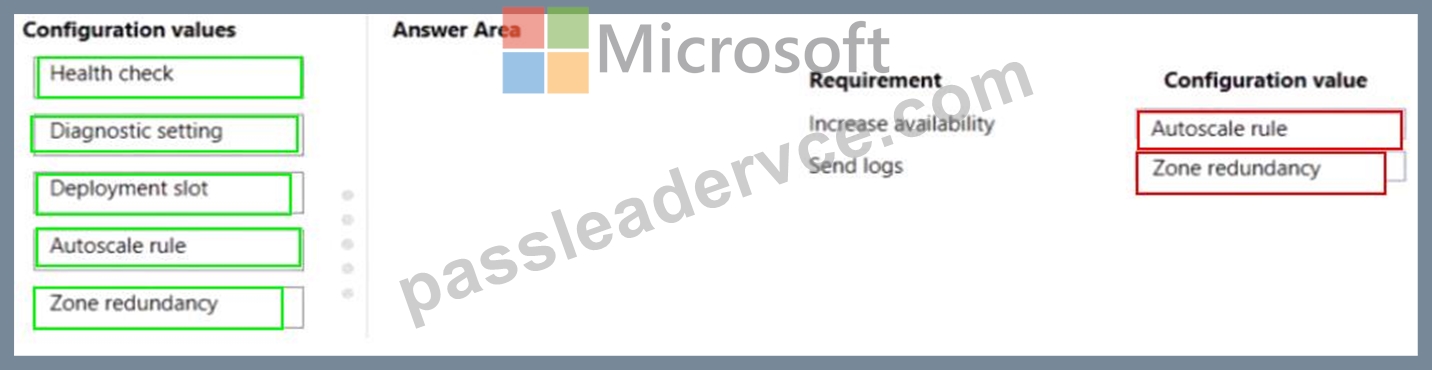
NEW QUESTION 139
You develop a web application.
You need to register the application with an active Azure Active Directory (Azure AD) tenant.
Which three actions should you perform in sequence? To answer, move all actions from the list of actions to the answer area and arrange them in the correct order.
Answer:
Explanation:
Explanation
Register a new application using the Azure portal
* Sign in to the Azure portal using either a work or school account or a personal Microsoft account.
* If your account gives you access to more than one tenant, select your account in the upper right corner.
Set your portal session to the Azure AD tenant that you want.
* Search for and select Azure Active Directory. Under Manage, select App registrations.
* Select New registration. (Step 1)
* In Register an application, enter a meaningful application name to display to users.
* Specify who can use the application. Select the Azure AD instance. (Step 2)
* Under Redirect URI (optional), select the type of app you're building: Web or Public client (mobile & desktop). Then enter the redirect URI, or reply URL, for your application. (Step 3)
* When finished, select Register.
NEW QUESTION 140
You develop and deploy an Azure App Service web app that connects to Azure Cache for Redis as a content cache. An resources have been deployed to East US 2 region.
The security team requires the from Azure Cache for Redis:
The number of Redis client connections from an associated IP address.
Redis operations completed on the content cache.
The location (region) in which the Azure Cache for Redis instance was accessed.
The audit information must be captured and analyzed by a security team application deployed to Central US region You need to log information on all client corrections to the cache.
Which configuration values should you use?
Answer:
Explanation:
NEW QUESTION 141
You are developing an ASP.NET Core web application. You plan to deploy the application to Azure Web App for Containers.
The application needs to store runtime diagnostic data that must be persisted across application restarts. You have the following code:
You need to configure the application settings so that diagnostic data is stored as required.
How should you configure the web app's settings? To answer, select the appropriate options in the answer area.
NOTE: Each correct selection is worth one point.
Answer:
Explanation:
Reference:
https://docs.microsoft.com/en-us/azure/app-service/containers/app-service-linux-faq
NEW QUESTION 142
Hotspot Question
You develop a microservice solution for a company.
The solution uses the Actor design pattern for all services including mappings, GPS, and communication. The mapping and communication systems must persist state on disk. The GPS system must persist state in-memory. All Actors must have a service replica count of three.
You need to implement code for the GPS system.
How should you complete the code segment? To answer, select the appropriate options in the answer area.
NOTE: Each correct selection is worth one point.
Answer:
Explanation:
Explanation:
Example:
The state manager retrieval methods return a reference to an object in local memory. Modifying this object in local memory alone does not cause it to be saved durably. When an object is retrieved from the state manager and modified, it must be reinserted into the state manager to be saved durably.
[StatePersistence(StatePersistence.Persisted)]
class MyActor : Actor, IMyActor
{
public MyActor(ActorService actorService, ActorId actorId) : base(actorService, actorId)
{
}
public Task SetCountAsync(int value)
{
return this.StateManager.SetStateAsync<int>("MyState", value);
}
}
References:
https://docs.microsoft.com/en-us/azure/service-fabric/service-fabric-reliable-actors-access-save- remove-state
NEW QUESTION 143
You are developing an application. You have an Azure user account that has access to two subscriptions.
You need to retrieve a storage account key secret from Azure Key Vault.
In which order should you arrange the PowerShell commands to develop the solution? To answer, move all commands from the list of commands to the answer area and arrange them in the correct order.
Answer:
Explanation:
1 - Get-AzSubscription
2 - Set-AzContext -SubscriptionId
3 - Get-AzStorageAccountKey
4 - $secretvalue = ConvertTo-SecureString <storageAccountKey> -AsPlainText -Force
5 - Get-AzKeyVaultSecret
Reference:
https://docs.microsoft.com/bs-latn-ba/Azure/key-vault/key-vault-key-rotation-log-monitoring
NEW QUESTION 144
You need to resolve the Shipping web site error.
How should you configre the Azure Table Storage service? To answer, select the appropriate options in the answer area.
NOTE: Each correct selection is worth one point.
Answer:
Explanation:
References:
https://developer.mozilla.org/en-US/docs/Web/HTTP/Headers/Access-Control-Allow-Origin
NEW QUESTION 145
You are preparing to deploy a Python website to an Azure Web App using a container. The solution will use multiple containers in the same container group. The Dockerfile that builds the container is as follows:
You build a container by using the following command. The Azure Container Registry instance named images is a private registry.
The user name and password for the registry is admin
The Web App must always run the same version of the website regardless of future builds.
You need to create an Azure Web App to run the website.
How should you complete the commands? To answer, select the appropriate options in the answer area.
NOTE: Each correct selection is worth one point.
Answer:
Explanation:
Explanation
Box 1: --SKU B1 --hyper-v
--hyper-v
Host web app on Windows container.
Box 2: --deployment-source-url images.azurecr.io/website:v1.0.0
--deployment-source-url -u
Git repository URL to link with manual integration.
The Web App must always run the same version of the website regardless of future builds.
Incorrect:
--deployment-container-image-name -i
Linux only. Container image name from Docker Hub, e.g. publisher/image-name:tag.
Box 3: az webapp config container set -url https://images.azurecr.io -u admin -p admin az webapp config container set Set a web app container's settings.
Paremeter: --docker-registry-server-url -r
The container registry server url.
The Azure Container Registry instance named images is a private registry.
Example:
az webapp config container set --docker-registry-server-url https://{azure-container-registry-name}.azurecr.io Reference:
https://docs.microsoft.com/en-us/cli/azure/appservice/plan
NEW QUESTION 146
You are developing an Azure-hosted application that must use an on-premises hardware security module (HSM) key.
The key must be transferred to your existing Azure Key Vault by using the Bring Your Own Key (BYOK) process.
You need to securely transfer the key to Azure Key Vault.
Which four actions should you perform in sequence? To answer, move the appropriate actions from the list of actions to the answer area and arrange them in the correct order.
Answer:
Explanation:
Text Description automatically generated
To perform a key transfer, a user performs following steps:
* Generate KEK.
* Retrieve the public key of the KEK.
* Using HSM vendor provided BYOK tool - Import the KEK into the target HSM and exports the Target Key protected by the KEK.
* Import the protected Target Key to Azure Key Vault.
Step 1: Generate a Key Exchange Key (KEK).
Step 2: Retrieve the Key Exchange Key (KEK) public key.
Step 3: Generate a key transfer blob file by using the HSM vendor-provided tool.
Generate key transfer blob using HSM vendor provided BYOK tool
Step 4: Run the az keyvault key import command
Upload key transfer blob to import HSM-key.
Customer will transfer the Key Transfer Blob (".byok" file) to an online workstation and then run a az keyvault key import command to import this blob as a new HSM-backed key into Key Vault.
To import an RSA key use this command:
az keyvault key import
Reference:
https://docs.microsoft.com/en-us/azure/key-vault/keys/byok-specification
NEW QUESTION 147
You are developing a solution for a hospital to support the following use cases:
* The most recent patient status details must be retrieved even if multiple users in different locations have updated the patient record.
* Patient health monitoring data retrieved must be the current version or the prior version.
* After a patient is discharged and all charges have been assessed, the patient billing record contains the final charges.
You provision a Cosmos DB NoSQL database and set the default consistency level for the database account to Strong. You set the value for Indexing Mode to Consistent.
You need to minimize latency and any impact to the availability of the solution. You must override the default consistency level at the query level to meet the required consistency guarantees for the scenarios.
Which consistency levels should you implement? To answer, drag the appropriate consistency levels to the correct requirements. Each consistency level may be used once, more than once, or not at all. You may need to drag the split bar between panes or scroll to view content.
NOTE: Each correct selection is worth one point.
Answer:
Explanation:
Reference:
https://docs.microsoft.com/en-us/azure/cosmos-db/consistency-levels
NEW QUESTION 148
You are developing a serverless Java application on Azure. You create a new Azure Key Vault to work with secrets from a new Azure Functions application.
The application must meet the following requirements:
* Reference the Azure Key Vault without requiring any changes to the Java code.
* Dynamically add and remove instances of the Azure Functions host based on the number of incoming application events.
* Ensure that instances are perpetually warm to avoid any cold starts.
* Connect to a VNet.
* Authentication to the Azure Key Vault instance must be removed if the Azure Function application is deleted.
You need to grant the Azure Functions application access to the Azure Key Vault.
Which three actions should you perform in sequence? To answer, move the appropriate actions from the list of actions to the answer area and arrange them in the correct order.
Answer:
Explanation:
Step 1: Create the Azure Functions app with a Consumption plan type.
Use the Consumption plan for serverless.
Step 2: Create a system-assigned managed identity for the application.
Create a system-assigned managed identity for your application.
Key Vault references currently only support system-assigned managed identities. User-assigned identities cannot be used.
Step 3: Create an access policy in Key Vault for the application identity.
Create an access policy in Key Vault for the application identity you created earlier. Enable the "Get" secret permission on this policy. Do not configure the "authorized application" or applicationId settings, as this is not compatible with a managed identity.
Reference:
https://docs.microsoft.com/en-us/azure/app-service/app-service-key-vault-references
NEW QUESTION 149
......
Difficulty in Writing AZ-204: Developing Solutions for Microsoft Azure Exam
AZ-204: Developing Solutions for Microsoft Azure is a privileged achievement one could be graced with. But adverse to general notion certifying with Microsoft is not that challenging if the candidates have proper preparation material to pass the AZ-204: Developing Solutions for Microsoft Azure exam with good grades. Questions answers and clarifications which are designed in form of PassLeaderVCE exam dumps make sure to cover entire course content. PassLeaderVCE have a brilliant AZ-204: Developing Solutions for Microsoft Azure exam dumps with most recent and important questions and answers in PDF files. PassLeaderVCE is sure about the exactness and legitimacy of AZ-204: Developing Solutions for Microsoft Azure exam dumps and in this manner. Candidates can easily pass the AZ-204: Developing Solutions for Microsoft Azure exam with genuine AZ-204: Developing Solutions for Microsoft Azure exam dumps and get MICROSOFT certification. These exam dumps are viewed as the best source to understand the AZ-204: Developing Solutions for Microsoft Azure well by simply pursuing examples questions and answers. If candidate completes practice the exam with certification AZ-204 exam dumps along with self-assessment to get the proper idea on MICROSOFT accreditation and to ace the certification exam.
How to Prepare For AZ-204: Developing Solutions for Microsoft Azure Exam
Preparation Guide for AZ-204: Developing Solutions for Microsoft Azure Exam
Introduction
Microsoft has created a track for cloud developers who want to validate foundational knowledge of Developing Solutions for Microsoft Azure landscape to get certified this platform. Cloud developers They partner with cloud DBAs, cloud administrators, and clients to implement solutions. Developing Solutions for Microsoft Azure professionals is a way to demonstrate their skills. The assessment is based on a rigorous exam using industry standard methodology to determine whether a candidate meets Microsoft's proficiency standards.
The AZ-204 Candidate will have the knowledge and skills to develop applications in a variety of configurations and use tools such as Visual Studio, ReSharper, Manifest Designer to manage the application life cycle. This candidate is also proficient in many of the Azure SDKs such as: C#, Ruby on Rails (with ActiveAdmin), Node.js (with Express), Python, PowerShell (with AzureRM). It will also have the ability to implement application patterns and best practices such as MVC, MVS, MVVM, REST, JSON , HTML, UI patterns and many more.
Certification is evidence of your skills, expertise in those areas in which you like to work. There are many vendors in the market that are providing these certifications. If candidate wants to work on Developing Solutions for Microsoft Azure and prove his knowledge, certification offered by Microsoft. This AZ-204 Exam Certification helps a candidate to validates his skills in Developing Solutions for Microsoft Azure Technology.
In this guide, we will cover the AZ-204: Developing Solutions for Microsoft Azure Certification exam, AZ-204: Developing Solutions for Microsoft Azure Certified professional salary and all aspects of the AZ-204: Developing Solutions for Microsoft Azure Certification.
Microsoft AZ-204: Selling Microsoft Azure Products and Solutions: https://www.passleadervce.com/Microsoft-Azure/reliable-AZ-204-exam-learning-guide.html
AZ-204 exam dumps and online Test Engine: https://drive.google.com/open?id=1s9WtXLjazI8mdKyNjKShK-Pw5UvcGgbu