

JN0-351 Exam Practice Questions prepared by Juniper Professionals
Use Valid New JN0-351 Questions - Top choice Help You Gain Success
Juniper JN0-351 Exam Syllabus Topics:
| Topic | Details |
|---|---|
| Topic 1 |
|
| Topic 2 |
|
| Topic 3 |
|
| Topic 4 |
|
| Topic 5 |
|
| Topic 6 |
|
| Topic 7 |
|
| Topic 8 |
|
NEW QUESTION # 19
You are concerned about spoofed MAC addresses on your LAN.
Which two Layer 2 security features should you enable to minimize this concern? (Choose two.)
- A. dynamic ARP inspection
- B. IP source guard
- C. static ARP
- D. DHCP snooping
Answer: A,D
Explanation:
* A is correct because dynamic ARP inspection (DAI) is a Layer 2 security feature that prevents ARP spoofing attacks. ARP spoofing is a technique that allows an attacker to send fake ARP messages to associate a spoofed MAC address with a legitimate IP address. This can result in traffic redirection, man-in-the-middle attacks, or denial-of-service attacks. DAI validates ARP packets by checking the source MAC address and IP address against a trusted database, which is usually built by DHCP snooping 1 . DAI discards any ARP packets that do not match the database or have invalid formats 1 .
* C is correct because DHCP snooping is a Layer 2 security feature that prevents DHCP spoofing attacks. DHCP spoofing is a technique that allows an attacker to act as a rogue DHCP server and offer fake IP addresses and other network parameters to unsuspecting clients. This can result in traffic redirection, man-in-the-middle attacks, or denial-of-service attacks. DHCP snooping filters DHCP messages by classifying switch ports as trusted or untrusted. Trusted ports are allowed to send and receive any DHCP messages, while untrusted ports are allowed to send only DHCP requests and receive only valid DHCP replies from trusted ports 2 . DHCP snooping also builds a database of MAC addresses, IP addresses, lease times, and binding types for each client 2 .
NEW QUESTION # 20
What is a purpose of using a spanning tree protocol?
- A. to look up MAC addresses
- B. to route IP packets
- C. to eliminate broadcast storms
- D. to tunnel Ethernet frames
Answer: C
Explanation:
A broadcast storm is a network condition where a large number of broadcast packets are sent and received by multiple devices, causing congestion and performance degradation1. A broadcast storm can occur when there are loops in the network topology, meaning that there are multiple paths between two devices2.
A spanning tree protocol is a network protocol that prevents loops from being formed when switches or bridges are interconnected via multiple paths. It does this by creating a logical tree structure that spans all the devices in the network, and disabling or blocking the links that are not part of the tree, leaving a single active path between any two devices3.
By eliminating loops, a spanning tree protocol also eliminates broadcast storms, as broadcast packets will not be forwarded endlessly along the looped paths. Instead, broadcast packets will be sent only along the tree structure, reaching each device once and avoiding congestion3.
NEW QUESTION # 21
When trying to commit the configuration shown in the exhibit, you receive an error.
What is the problem?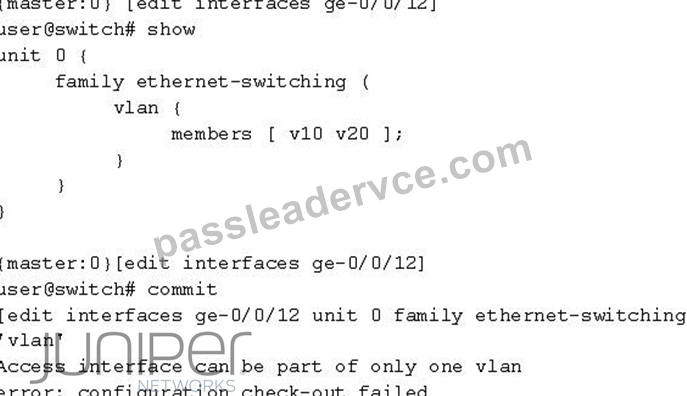
- A. You have omitted the interface-mode accesscommand.
- B. You have omitted the interface-mode trunkcommand.
- C. You have not set the interface family correctly.
- D. You have not configured an IP address to the interface.
Answer: B
NEW QUESTION # 22
Which mechanism is used to share routes between routing tables?
- A. filter-based forwarding
- B. RIB groups
- C. routing instances
- D. forwarding instances
Answer: B
NEW QUESTION # 23
What are two characteristics of RSTP alternate ports? (Choose two.)
- A. RSTP alternate ports block traffic while receiving superior BPDUs from a neighboring switch.
- B. RSTP alternate ports are active ports used to forward frames toward the root bridge.
- C. RSTP alternate ports provide an alternate lower cost path to the root bridge.
- D. RSTP alternate ports provide an alternate higher cost path to the root bridge.
Answer: A,D
Explanation:
A is correct because RSTP alternate ports block traffic while receiving superior BPDUs from a neighboring switch. An alternate port is a backup port for a root port, which means it receives better BPDUs from another bridge than the current root port1. However, an alternate port does not forward any traffic, as it is in a discarding state2. It only listens to BPDUs and waits for the root port to fail. If the root port fails, the alternate port can immediately transition to a forwarding state and become the new root port1.
C is correct because RSTP alternate ports provide an alternate higher cost path to the root bridge. An alternate port is selected based on the same criteria as the root port, which are the lowest bridge ID, the lowest path cost, the lowest sender port ID, and the lowest receiver port ID3. However, an alternate port receives a higher cost BPDU than the root port, otherwise it would be the root port itself1. Therefore, an alternate port provides an alternate higher cost path to the root bridge than the root port.
NEW QUESTION # 24
Exhibit.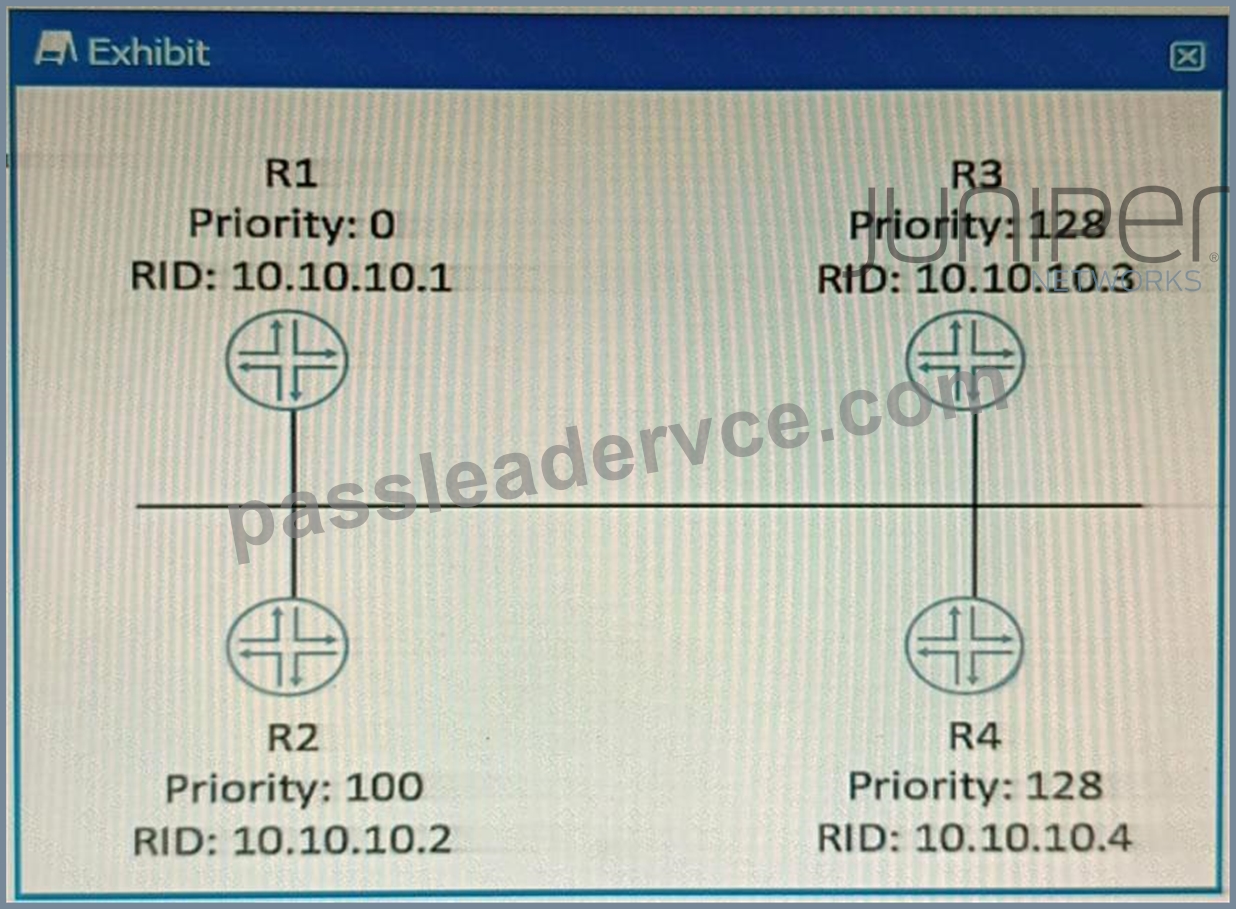
Which router will become the OSPF BDR if all routers are powered on at the same time?
- A. R3
- B. R4
- C. R1
- D. R2
Answer: B
Explanation:
Explanation
OSPF DR/BDR election is a process that occurs on multi-access data links. It is intended to select two OSPF nodes: one to be acting as the Designated Router (DR), and another to be acting as the Backup Designated Router (BDR).The DR and BDR are responsible for generating network LSAs for the multi-access network and synchronizing the LSDB with other routers on the same network1.
The DR/BDR election is based on two criteria: the OSPF priority and the router ID. The OSPF priority is a value between 0 and 255 that can be configured on each interface participating in OSPF. The default priority is
1. A priority of 0 means that the router will not participate in the election and will never become a DR or BDR. The router with the highest priority will become the DR, and the router with the second highest priority will become the BDR. If there is a tie in priority, then the router ID is used as a tie-breaker. The router ID is a
32-bit number that uniquely identifies each router in an OSPF domain.It can be manually configured or automatically derived from the highest IP address on a loopback interface or any active interface2.
In this scenario, all routers have the same priority of 1, so the router ID will determine the outcome of the election. The router IDs are shown in the exhibit as RID values. The highest RID belongs to R4 (10.10.10.4), so R4 will become the DR. The second highest RID belongs to R3 (10.10.10.3), so R3 will become the BDR.
References:
1:OSPF DR/BDR Election: Process, Configuration, and Tuning2:OSPF Designated Router (DR) and Backup Designated Router (BDR)
NEW QUESTION # 25
You want to ensure traffic is routed through a GRE tunnel.
In this scenario, which two statements will satisfy this requirement? (Choose two.)
- A. BFD must be used on the stateless tunneling protocols.
- B. Tunnel endpoints must have a route that directs traffic into the tunnel.
- C. Keepalives must be used on stateless tunneling protocols.
- D. All intermediary devices must have a route to the tunnel endpoints.
Answer: B,D
Explanation:
Option A is correct. For traffic to be sent through a GRE tunnel, there must be a route that directs the traffic into the tunnel. This is typically accomplished through the use of a static route or a dynamic routing protocol.
Option B is correct. All intermediary devices must have a route to the tunnel endpoints34. In real-world scenarios, the tunnel endpoints for a tunnel going over the Internet must have globally reachable internet addresses. Otherwise, intermediate routers in the Internet cannot forward the tunneled packets.
NEW QUESTION # 26
You have two OSPF routers forming an adjacency. R1 has a priority of 32 and a router ID of 192.168.1.2. R2 has a priority of 64 and a router ID of 192.168.1.1. The routers were started at the same time and all other OSPF settings are the default settings.
Which statement is correct in this scenario?
- A. R1 will be the BDR.
- B. Router IDs must match for an adjacency to form.
- C. At least three routers are required for a DR/BDR election
- D. R2 will be the BDR.
Answer: A
Explanation:
Explanation
In OSPF, the Designated Router (DR) and Backup Designated Router (BDR) are elected based on the priority of the routers1. The router with the highest priority becomes the DR, and the router with the second highest priority becomes the BDR1. If there is a tie in priority, then the router with the highest Router ID is chosen1.
In this scenario, R2 has a higher priority (64) than R1 (32), so R2 will become the DR1. Since R1 has the second highest priority, it will become the BDR1. Therefore, option D is correct.
NEW QUESTION # 27
You have two OSPF routers forming an adjacency. R1 has a priority of 32 and a router ID of 192.168.1.2. R2 has a priority of 64 and a router ID of 192.168.1.1. The routers were started at the same time and all other OSPF settings are the default settings.
Which statement is correct in this scenario?
- A. Router IDs must match for an adjacency to form.
- B. At least three routers are required for a DR/BDR election.
- C. R2 will be the BDR.
- D. R1 will be the BDR.
Answer: C
Explanation:
In OSPF, a DR (Designated Router) and a BDR (Backup Designated Router) are elected on each multi-access network, such as Ethernet or Frame Relay. The DR and BDR are responsible for exchanging routing information with other routers on the same network segment. The election is based on two criteria: the OSPF priority and the router ID. The router with the highest priority becomes the DR, and the router with the second-highest priority becomes the BDR. If the priorities are equal, the router with the highest router ID becomes the DR, and the router with the second-highest router ID becomes the BDR. The default priority is 1, and the router ID is either manually configured or derived from the highest IP address on any interface12.
In this scenario, R1 has a priority of 32 and a router ID of 192.168.1.2, and R2 has a priority of 64 and a router ID of 192.168.1.1. Since R2 has a higher priority than R1, it will become the BDR. The router ID does not matter in this case, because the priority is different. Therefore, the correct answer is C.
The other options are not correct because:
A). At least two routers are required for a DR/BDR election, not three2.
B). Router IDs do not have to match for an adjacency to form, they just have to be unique3.
D). R1 will not be the BDR, because it has a lower priority than R212.
References: Understanding OSPF Areas | Junos OS, OSPF DR/BDR Election explained - NetworkLessons.
com, OSPF adjacency - Cisco Community
NEW QUESTION # 28
You enable persistent MAC learning on your Juniper switch
In this scenario, which statement is correct?
- A. You can enable persistent MAC learning on an interface that is part of a redundant trunk group.
- B. You can only enable persistent MAC learning on an interface on which 802.1x authentication is configured.
- C. You can enable persistent MAC learning on an interface where MAC learning is disabled.
- D. You can only enable persistent MAC learning on an interface in access mode.
Answer: D
NEW QUESTION # 29
Which two actions are performed by the firewall filter shown in the exhibit? (Choose two.)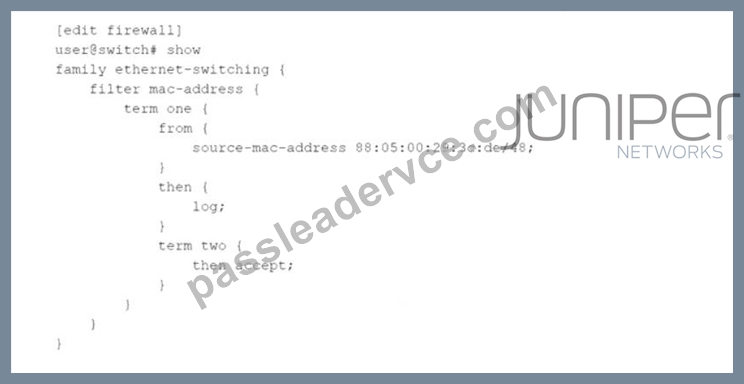
- A. Term two requires a from statement.
- B. Frames without the 88:05:00:29:3c:de source MAC address are discarded and logged.
- C. All traffic is permitted.
- D. Frames with the 88:05:00:29:3c:de source MAC address are accepted and logged.
Answer: C,D
Explanation:
References:
* Enterprise Routing and Switching, Specialist (JNCIS-ENT) - Juniper Networks
* Enterprise Routing and Switching, Specialist (JNCIS-ENT) - Juniper Networks
* Juniper Networks Certified Specialist, Enterprise Routing & Switching ...
* Juniper Networks Certified Specialist, Enterprise Routing & Switching ...
* [Configuring Layer 2 Firewall Filters - TechLibrary - Juniper Networks]
* [Understanding Firewall Filter Terms - TechLibrary - Juniper Networks]
NEW QUESTION # 30
Exhibit.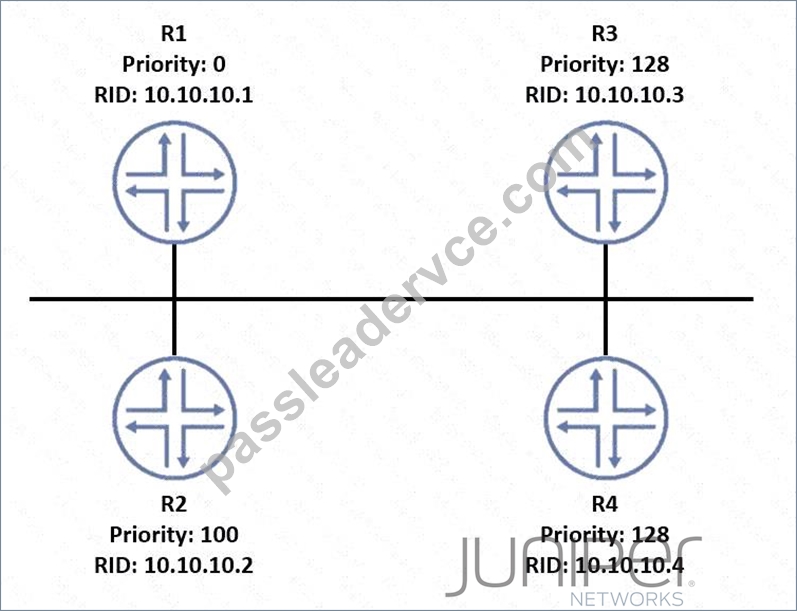
Which router will become the OSPF BDR if all routers are powered on at the same time?
- A. R3
- B. R4
- C. R1
- D. R2
Answer: B
Explanation:
OSPF DR/BDR election is a process that occurs on multi-access data links. It is intended to select two OSPF nodes: one to be acting as the Designated Router (DR), and another to be acting as the Backup Designated Router (BDR). The DR and BDR are responsible for generating network LSAs for the multi-access network and synchronizing the LSDB with other routers on the same network 1 .
The DR/BDR election is based on two criteria: the OSPF priority and the router ID. The OSPF priority is a value between 0 and 255 that can be configured on each interface participating in OSPF. The default priority is 1. A priority of 0 means that the router will not participate in the election and will never become a DR or BDR. The router with the highest priority will become the DR, and the router with the second highest priority will become the BDR. If there is a tie in priority, then the router ID is used as a tie-breaker. The router ID is a
32-bit number that uniquely identifies each router in an OSPF domain. It can be manually configured or automatically derived from the highest IP address on a loopback interface or any active interface 2 .
In this scenario, all routers have the same priority of 1, so the router ID will determine the outcome of the election. The router IDs are shown in the exhibit as RID values. The highest RID belongs to R4 (10.10.10.4), so R4 will become the DR. The second highest RID belongs to R3 (10.10.10.3), so R3 will become the BDR.
References:
1 : OSPF DR/BDR Election: Process, Configuration, and Tuning 2 : OSPF Designated Router (DR) and Backup Designated Router (BDR)
NEW QUESTION # 31
You are deploying an EX Series switch with a Wi-Fi access point. The access point needs all untagged traffic to use a specific VLAN. In this scenario, which feature should you enable on the switch port?
- A. voice VLAN
- B. flexible VLAN tagging
- C. VLAN tagging
- D. native VLAN
Answer: D
NEW QUESTION # 32
You manage the Layer 2 network shown in the exhibit. You experience a failure on the ge-0/0/0 link between Switch-1 and Switch-2.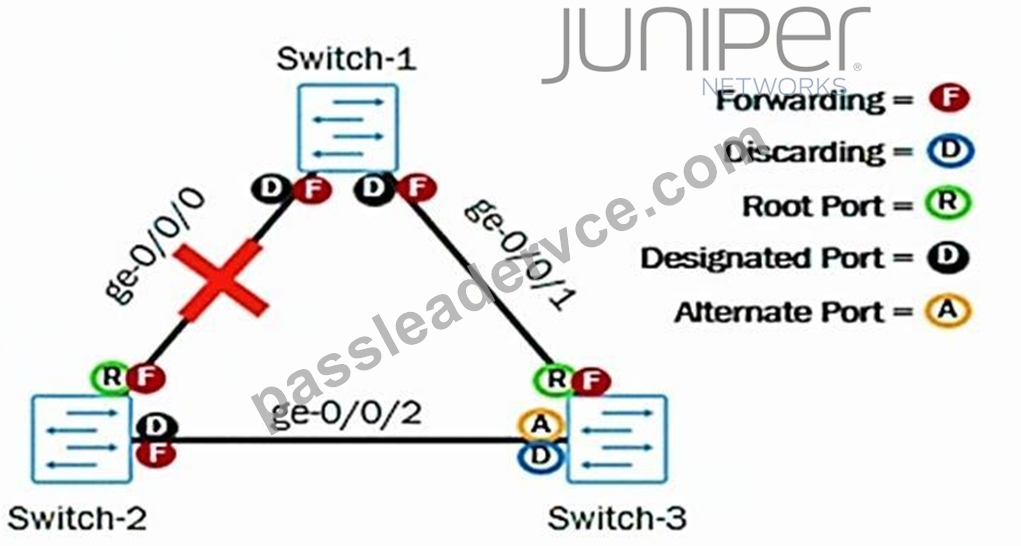
Which statement is correct about the expected behavior?
- A. Switch-2's ge-0/0/2 port role and state will transition to root and forwarding
- B. Switch-2 will remove itself from the RSTP topology
- C. Switch-2's ge-0/0/2 port role and state will remain as designated and forwarding
- D. Switch-2 will become the root bridge for a separate RSTP topology
Answer: A
NEW QUESTION # 33
Exhibit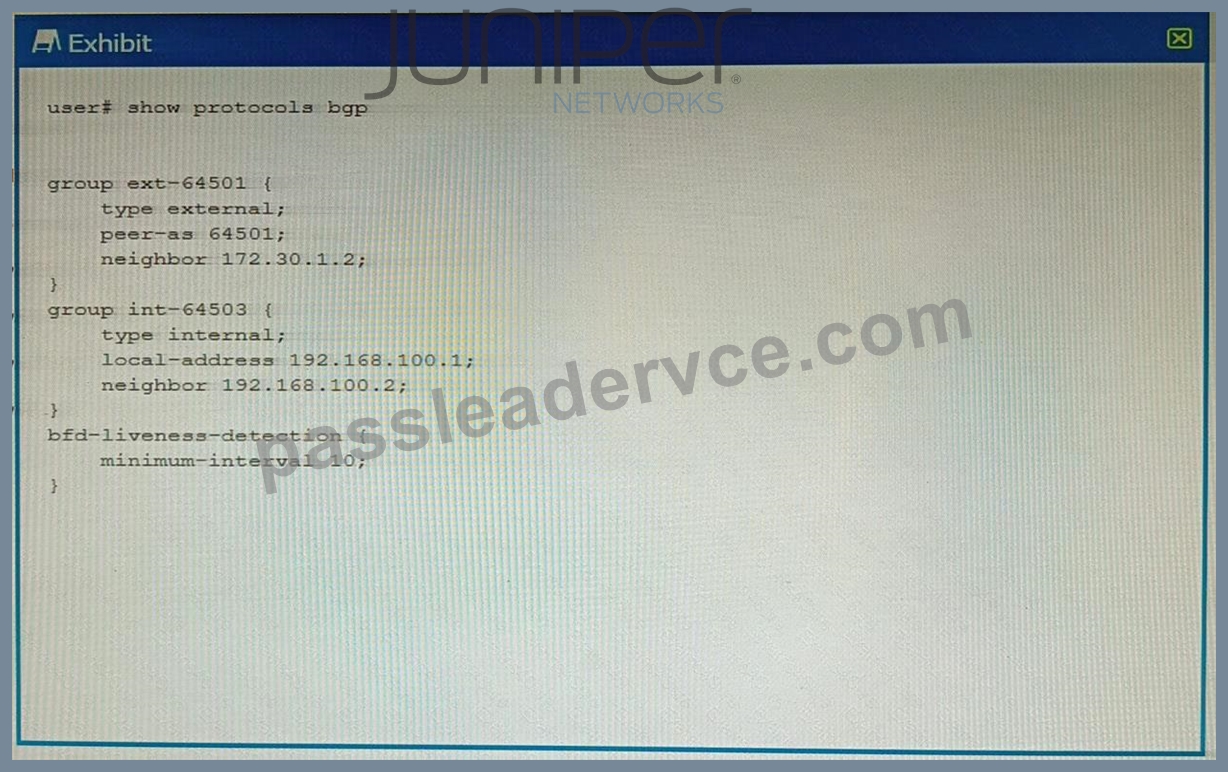
Your BGP neighbors, one in the USA and one in France, are not establishing a connection with each other.
Referring to the exhibit, which statement is correct?
- A. The BFD liveness is set too high.
- B. The BFD liveness must be configured on the BGP neighbor.
- C. The BFD liveness must be configured on the BGP group.
- D. The BFD liveness is set too low.
Answer: B
Explanation:
Explanation
The exhibit shows the configuration of BFD liveness detection for BGP at the global level, which applies to all BGP neighbors by default1. However, this configuration does not specify the session mode, which determines whether BFD uses single-hop or multihop mode to communicate with a neighbor2.
For single-hop BGP neighbors, which are directly connected on the same subnet, the session mode can be either automatic or single-hop. For multihop BGPneighbors, which are not directly connected and require multiple hops to reach, the session mode must be multihop2.
Since your BGP neighbors are in different countries, they are likely to be multihop neighbors. Therefore, you need to configure the session mode as multihop for each neighbor individually at the [edit protocols bgp group group-name neighbor address bfd-liveness-detection] hierarchy level2. For example:
protocols { bgp { group usa { neighbor 192.0.2.1 { bfd-liveness-detection { session-mode multihop; } } } group france { neighbor 198.51.100.1 { bfd-liveness-detection { session-mode multihop; } } } } } If you do not configure the session mode for multihop neighbors, BFD will use the default mode of automatic, which will try to use single-hop mode and fail to establish a BFD session with the remote neighbor2. This will prevent BGP from using BFD to detect liveliness and failover.
Therefore, the answer B is correct, as you need to configure the BFD liveness detection on the BGP neighbor level with the appropriate session mode for multihop neighbors.
NEW QUESTION # 34
Which two statements are correct about using firewall filters on EX Series switches? (Choose two.)
- A. You can deploy both stateless and stateful firewall filters on an EX Series switch.
- B. You can only apply firewall filters to Layer 2 traffic on an EX Series switch.
- C. You can deploy only stateless firewall filters on an EX Series switch.
- D. You can apply firewall filters to both Layer 2 and Layer 3 traffic on an EX Series switch.
Answer: C,D
Explanation:
A is correct because you can deploy only stateless firewall filters on an EX Series switch. A stateless firewall filter is a filter that evaluates each packet individually based on the header information, such as source and destination addresses, protocol, and port numbers1. A stateless firewall filter does not keep track of the state or context of a packet flow, such as the sequence number, flags, or sessioninformation1. EX Series switches support only stateless firewall filters, which are also called access control lists (ACLs) or packet filters2.
C is correct because you can apply firewall filters to both Layer 2 and Layer 3 traffic on an EX Series switch. Layer 2 traffic is traffic that is switched within a VLAN or a bridge domain, while Layer 3 traffic is traffic that is routed between VLANs or networks3. EX Series switches support three types of firewall filters: port (Layer 2) firewall filters, VLAN firewall filters, and router (Layer 3) firewall filters4. You can apply these filters to different interfaces and directions to control the traffic entering or exiting the switch.
NEW QUESTION # 35
Two routers share the same highest priority and start time. In this situation, what is evaluated next when determining the designated router?
- A. The router with the highest router ID becomes the DR
- B. The routers perform another DR election.
- C. The router with the highest MAC address become the DR
- D. The router with the lowest router ID become the DR.
Answer: A
Explanation:
According to the OSPF protocol, the designated router (DR) is the router that acts as the focal point for exchanging routing information on a multi-access network segment, such as a LAN. The DR election process is based on the following criteria, in order of precedence:
The router with the highest OSPF priority becomes the DR. The default priority is 1, and a priority of 0 means the router will not participate in the election.
If there is a tie in priority, the router with the highest router ID becomes the DR. The router ID is a
32-bit number that uniquely identifies a router in an OSPF domain. It can be manually configured or automatically derived from the highest IP address of a loopback interface or a physical interface. If there is a tie in router ID, the router that was first to become an OSPF neighbor becomes the DR. In your scenario, two routers share the same highest priority and start time.
This means that they have equal chances of becoming the DR based on the first and third criteria. Therefore, the second criterion will be used to break the tie, which is the router ID. The router with the highest router ID will become the DR, and the other router will become the backup designated router (BDR), which is ready to take over the role of DR if it fails.
NEW QUESTION # 36
Referring to the output shown in the exhibit, which statement is correct?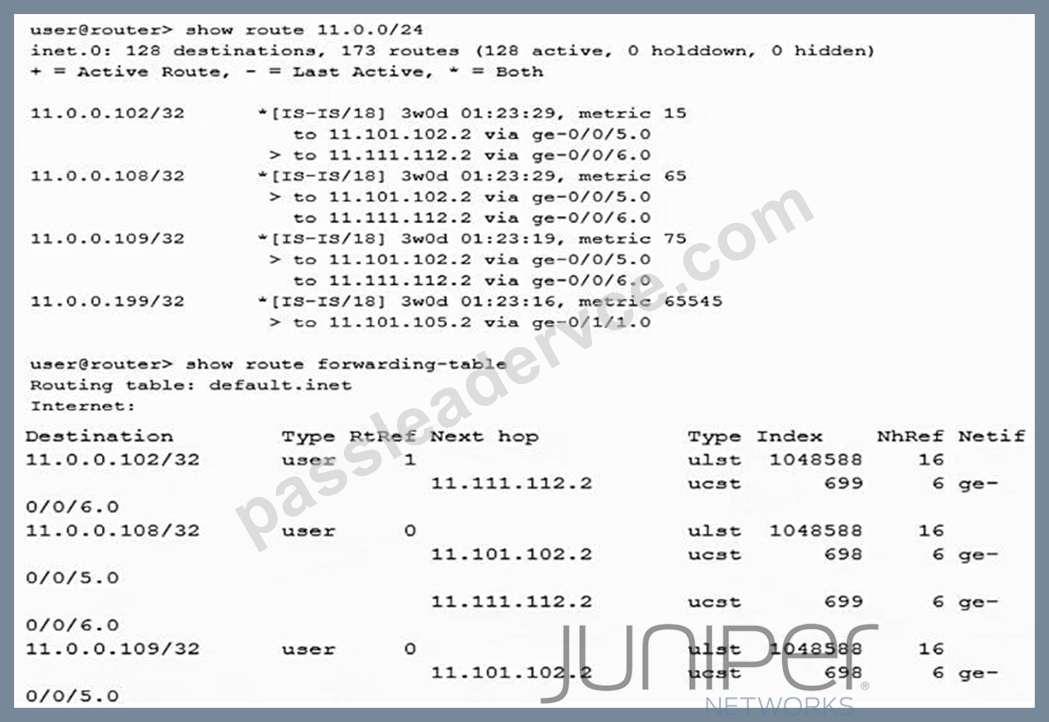
- A. 11.0.0.102/32 is being per-packet load-balanced
- B. 11.0.0.108/32 is being per-packet load-balanced
- C. 11.0.0.108/32 is being per-flow load-balanced
- D. 11.0.0.102/32 is being per-flow load-balanced
Answer: B
NEW QUESTION # 37
You are asked to explore adding BGP route reflectors to allow for increased scale in your core network.
Which statement is correct in this scenario?
- A. Route reflectors are required whenever internal BGP (IBGP) sessions are needed.
- B. The cluster ID is required to prevent routing loops.
- C. The cluster ID is not required to use route reflectors.
- D. Route reflectors require that the network is connected in a physical full mesh.
Answer: B
Explanation:
A route reflector is a BGP router that is allowed to break the iBGP loop avoidance rule and advertise routes received from an iBGP peer to another iBGP peer under specific conditions 1 . A route reflector can have three types of peerings: EBGP neighbor, IBGP client neighbor, and IBGP non-client neighbor 2 . A cluster is a group of route reflectors and their clients that are fully meshed 3 . The cluster ID is a 4-byte value that identifies the route reflector cluster and is carried in the ORIGINATOR_ID attribute of the BGP update message 4 . The cluster ID is used to prevent routing loops among route reflectors and their clients. If a route reflector receives a route with its own cluster ID, it discards the route 5 . Therefore, the cluster ID is required to prevent routing loops when using route reflectors.
References:
1 : What is BGP Route Reflector - Explanation & Discussion (Cisco Example)
2 : BGP Route Reflector - NetworkLessons.com
3 : BGP Route Reflectors (RR) - Cisco Community
4 : Junos OS Routing Protocols Library for Routing Devices
5 : Junos OS Routing Protocols Library for Routing Devices
NEW QUESTION # 38
Which statement is true about IP-IP tunnels?
- A. IP-IP tunnels are protocol agnostic.
- B. The packet header is replaced before entering the tunnel.
- C. The packet is encapsulated unchanged before entering the tunnel.
- D. The time-to-live value of the original packet is decremented.
Answer: A
NEW QUESTION # 39
......
JN0-351 Exam Practice Materials Collection: https://www.passleadervce.com/JNCIS-ENT/reliable-JN0-351-exam-learning-guide.html
Get Latest and 100% Accurate JN0-351 Exam Questions: https://drive.google.com/open?id=1NLFRu0t2GZf7uoV7VDq-tBoFshXSSNbG